An item per new ASIN going live
Opened the moment SP-API shows the listing is actually active.
Launch Item Sync +Amazon Seller launch boards
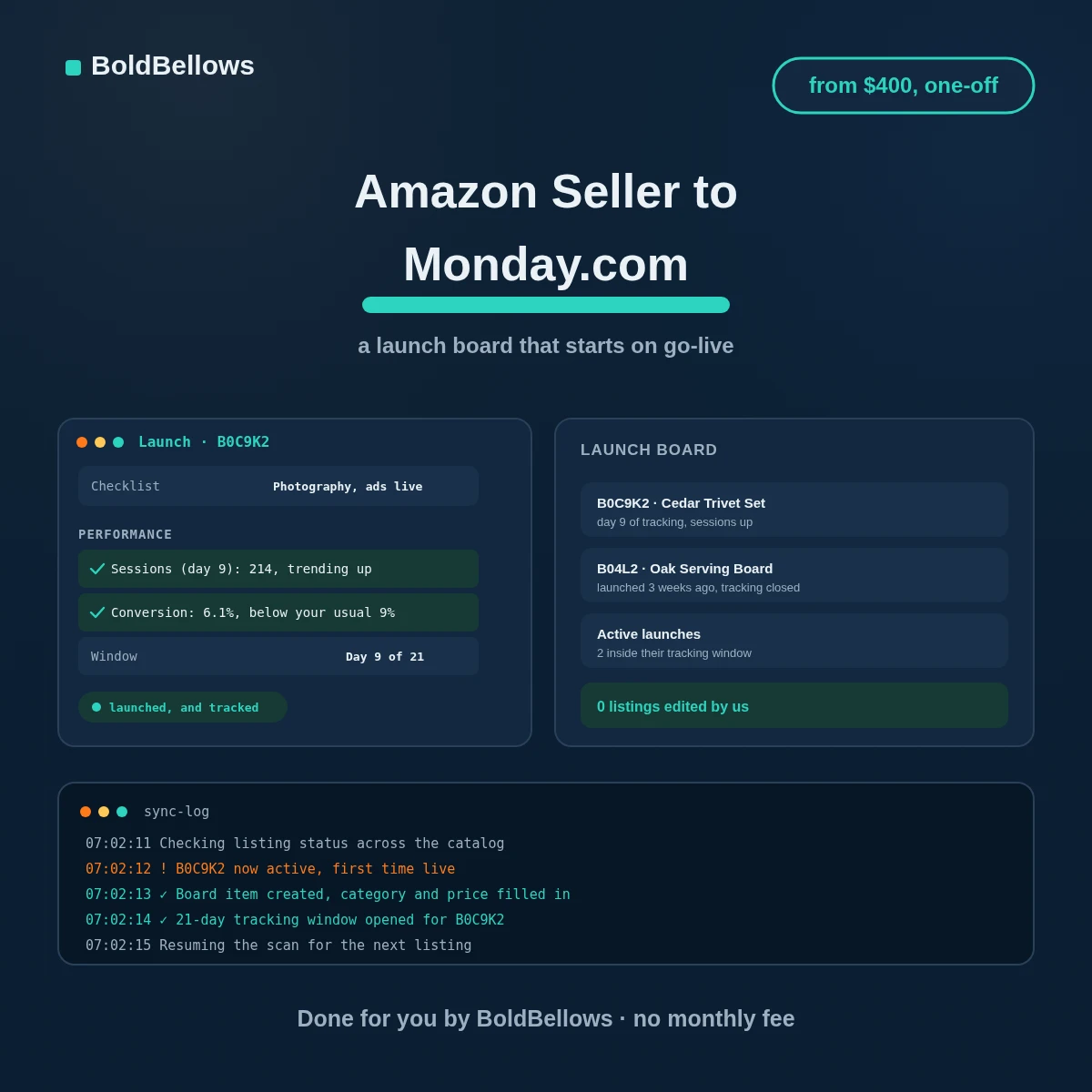
A finished checklist doesn't mean a launch is succeeding. The moment SP-API shows a listing has flipped to active, we start a board item with real catalog data on it, then keep sessions, conversion and reviews updating alongside your own launch steps for the weeks that decide whether it takes off.
From $400, paid once. No per-seat automation bill.
01 · a checked box isn't the same as a working launch
Sourcing done, listing live, photography uploaded, ads switched on — every box ticked, and the launch can still be quietly failing underneath. By the time someone thinks to check sessions and conversion by hand, the window where it mattered most has usually already closed.
02 · how it works
Keys scoped to your catalog alone watch listing status on a schedule. The instant one flips from inactive to buyable for the first time, a board item opens carrying that listing's real details, not a stand-in someone fills in later.
Which steps your team tracks today, and which numbers you'd actually want watched once a listing goes live.
Catalog data lands the moment the listing does, no one has to remember to add it manually.
A real recent listing walks through the whole build before you ever see the board yourself.
03 · inside a launch item
Everyone who touches the launch, from sourcing to ads, can see the same item and the same numbers, instead of five people checking five different places.
One launch item: what's been done, what the numbers are doing, and how far into the tracking window it sits.
Opened the moment SP-API shows the listing is actually active.
Launch Item Sync +Real numbers, not a figure someone pulled once and forgot.
Live Performance Columns +Seeing both together shows whether trust is building as fast as traffic.
Live Performance Columns +Sourcing, listing, photography and ads as real stages on the item.
Full Launch Command CenterEvery item laid out against the calendar, not buried in a list.
Full Launch Command CenterOne daily message naming every launch still worth watching closely.
Extra04 · who it's for
Sourcing, listing content, photography and advertising rarely sit with the same person. Whoever's watching a launch needs one place that reflects all of it.
"Half our launches, we don't actually know how they did."
Now every one gets its own item and its own real numbers from day one.
"By the time I hear a launch is struggling, it's already been weeks."
The same item shows the content team's work and the ad team's early results.
"I want to see how new products are doing without a status meeting."
A timeline view gives that answer without anyone having to compile it.
"Every client wants their own view of how their launches are going."
Connected boards and multi-brand structure keep each client's launches distinct.
Priced by how much of the launch actually gets tracked
Launch Item Sync, Live Performance Columns or Full Launch Command Center as your starting point, then which listings qualify and how far the board's structure goes. From $400, one payment.
05 · compare your options
Two of these can tell you a launch happened. Only one of them tells you whether it actually worked.
| What actually matters | A shared spreadsheet | A bare Zapier item | BoldBellows |
|---|---|---|---|
| Opens itself when a listing goes live | Only if someone remembers to add a row | Possible off a trigger you'd design yourself | Fires off the real go-live signal |
| Tracks performance, not just tasks | Whatever someone last remembered to paste in | An item gets made, then usually sits still | Columns that keep updating through the window |
| Effort as launches happen more often | Gets messier with every new tab someone adds | Billed per run, rising as launches climb | One setup invoice starting at $400, full stop |
| Who can actually read the setup | Anyone, though formulas rot fast unattended | Buried in whoever built the original zap | Spelled out in the notes you keep |
A basic go-live trigger alone can miss a relisting entirely, since the ASIN technically existed before and doesn't read as new.
Widening scope to relaunches means a suppression-and-recovery still opens its own tracked item.
A fixed three-week tracking window can close right as a slower-building product finally starts to find traction.
Extended tracking keeps the columns updating past the standard window for exactly that kind of launch.
Pick a package, answer three short questions about which listings start a board item, what data shows up on it, and how the board is structured, and your price and go-live date move as you choose.
06 · process & getting started
Five stages take this from a conversation about your launch steps to a board already holding a real, tracked item. We carry the technical build ourselves; your part is telling us, accurately, who handles what in the run-up to a listing going live.
Who handles sourcing, listing content, photography and ads today, and which of those steps deserve their own column.
Keys scoped to your Amazon Seller account alone, and a Monday.com connection, both set up on the same call.
Status columns, performance columns and whichever view you picked all take shape around what step one told us.
Whatever's actually active in your catalog is what opens the first real item, before you ever look at the board.
You see exactly how a go-live turns into a tracked item, then every future launch does the same without us involved.
The build doesn't begin until we're actually holding your SP-API keys and a Monday.com invite. A faster speed tier at checkout is the one thing that pulls the date in.
Your normal Seller Central access lets us mint a credential scoped strictly to this build, nothing wider.
Enough for us to add the connection and build out the board, even briefly.
Enough detail that the status columns match steps people already recognize.
The launch board sits alongside your existing work, and connects to it where you ask.
07 · security and ownership
Opening an item and keeping its columns current is the entire job this credential has. Changing anything about a listing, a price or an order sits completely outside what it's able to do.
Editing a listing, changing a price or touching an order sits outside anything this credential can attempt.
What flows into the board is catalog and performance data about your listings, never who bought them.
New launches show up exclusively on the board you pointed us to during setup, nowhere else.
No further item opens, and every item already sitting on the board stays exactly as it was.
A check happens, a column changes, and that's the entire footprint left behind each time.
Nothing about it depends on BoldBellows staying involved. It's simply part of how your Monday.com runs now.
08 · verified reviews
Verified reviews from business owners who use BoldBellows automations every day, across operations, support, sales and reporting, in the Amazon Seller to Monday.com route.
AI Customer Journey Automation
We wanted a smoother path from first contact to purchase. BoldBellows built an AI system that guides each customer there automatically.
It sends personalized messages, recommends products and follows up at just the right moment. Customer retention has improved dramatically.
AI Email & Smart Inbox Management
Our inbox used to be chaos. BoldBellows built an AI email system that sorts messages, drafts replies and flags anything urgent.
It learns how we write and gets better every week. We reply faster and no longer miss important messages. It feels like having a personal assistant working around the clock.
AI Translation & Localisation
When we expanded abroad we needed fast, accurate translations. BoldBellows built an AI translation system that turns our content into several languages instantly.
The translations read naturally and suit each culture. We now serve customers in five new countries without hiring translators. BoldBellows helped us go global.
AI Content & Social Media Automation
Our marketing agency couldn’t keep up with content. BoldBellows set up an AI content engine that writes blog posts and captions and even designs our social media creatives.
It spots trends and suggests topics for us, so we stay ahead of competitors. We now produce three times the content with the same team, and engagement has soared. They didn’t just automate our workflow, they lifted our whole brand.
AI CRM Automation
Our CRM was barely used because updating it by hand was tedious. BoldBellows automated data entry, tagging, segmentation and follow-ups.
Now the CRM is always up to date and our campaigns are far more accurate. It improved our whole sales pipeline.
AI Accounting & Invoice Automation
BoldBellows automated our whole invoicing process: creating invoices, sending reminders and tracking payments.
Late payments dropped sharply, and our accounting team finally has time for strategy instead of repetitive admin. Worth every penny.
AI Video & Voice Automation
We publish product videos every week, and BoldBellows introduced us to AI video automation. The system writes the script, voices it and produces the finished video in minutes.
The quality is remarkable: professional voiceovers, clean visuals and smooth editing. Production time went from three days to under 30 minutes, and we scaled our video marketing without adding cost.
AI E-commerce Listings Automation
BoldBellows automated our product listings. The AI writes descriptions, organizes photos and publishes listings across several marketplaces.
It even answers customer questions instantly. Our store looks more professional and sales have noticeably increased.
AI Workflow Automation for Agencies
Running a digital agency with many clients was overwhelming. BoldBellows built one automation dashboard that tracks tasks, sends updates and creates client reports automatically.
Clients love the transparency and we love the time we get back. Productivity is up, and project delays have dropped to almost zero.
AI Chatbot & Customer Support
BoldBellows built an AI support chatbot for our online boutique, and it has changed how we run the business. We used to have two full-time staff answering the same questions all day. Now the AI handles order tracking, product recommendations and even refund requests on its own.
What surprised me most is how natural it sounds. Customers compliment the ‘agent’ without realizing it’s AI. Our support workload dropped by 75% and customer satisfaction went up dramatically.
AI Lead Qualification & Sales Automation
Our sales team wasted hours chasing cold leads. BoldBellows built an AI lead-scoring system that reads behavior, email engagement and buying signals.
It filters out weak leads and sends personalized follow-ups automatically, so our team only talks to people who are ready to buy. Conversions rose 40% in the first month. It paid for itself straight away.
AI Booking & Scheduling Automation
Our coaching business needed a better way to schedule. BoldBellows automated all of it: bookings, reminders, cancellations and follow-ups.
No-shows fell by 60% and clients enjoy how smooth it is. It feels personal, not robotic. One of the best upgrades we’ve made.
AI HR & Recruitment Automation
Our HR team was drowning in applications. BoldBellows automated screening, skills-based filtering and interview scheduling.
It saves us hours every week and means we only interview qualified people. Hiring is now faster, better organized and more professional.
AI Data Entry & Reporting Automation
We used to spend hours collecting data and building weekly reports by hand. BoldBellows automated all of it.
The reports are clean, visual and easy to read, and our managers rely on them for quick decisions. Human error is gone and our numbers are more accurate across the board.
AI Document & Contract Automation
Onboarding was slow because we wrote every contract by hand. BoldBellows automated the lot: contracts, welcome emails and client setup.
What took 48 hours now takes under 10 minutes, and clients regularly tell us how professional it feels.
AI Social Comment & DM Automation
We get thousands of comments and messages every week. BoldBellows built an AI system that replies instantly, filters spam and surfaces the important ones.
Engagement is up and our page looks active around the clock. It’s like having a full social media team that never stops.
AI Voice Assistant
BoldBellows built a custom AI voice assistant for our customer hotline. It answers questions, books appointments and handles simple requests.
Customers love how fast it is, and our call-centre workload dropped dramatically. One of the smartest upgrades we’ve made.
AI Automation Partner
BoldBellows is hands-down the best AI automation partner we’ve worked with. Their systems are fast, reliable and built around how our business actually works.
Every automation they’ve delivered, from customer service to content, runs flawlessly. We’ve saved time, cut costs and grown faster than we expected.
09 · questions
Taken from real planning conversations with sellers before earlier boards went live. Bring anything specific to how you launch to a quote request.
It watches listing status through SP-API and treats a shift into an active, buyable state as the trigger. A listing sitting in draft or incomplete doesn't count until it genuinely goes live.
They tell you that it is, early enough to act, rather than why on their own. Seeing sessions climbing while conversion lags, for instance, usually points a listing-content review in the right direction.
Making one item from one trigger is easy enough, but keeping several columns updated daily off real sales and traffic data for three weeks per launch isn't a prebuilt action, so that logic becomes yours to maintain, on a bill that climbs with launch volume. We build it once and it's just how the board behaves from then on.
With the multi-marketplace extra, yes — each item picks up a tag showing which marketplace it launched on, so everything stays on one board without blending together.
Yes, on the Full Launch Command Center package. A launch item can mirror status from a separate inventory or ad-spend board instead of duplicating that information here.
No. The credential only reads, nothing gets stored anywhere but your own board, and the invoice at setup is the only one we send.
Columns typically freeze in place rather than silently showing wrong numbers, and anyone scanning the board will spot the stall quickly. Add the aftercare extra and repairing that mapping within 90 days costs nothing further.
Stop finding out a launch struggled a month too late
Set your price with the options below, or tell us about a longer tracking window, a board split by brand, or a structure these three packages don't name. Setup starts at $400, one invoice, nothing recurring after it.
Launching across several brands, or want a board shaped differently than these three? Tell us how your team actually runs a launch and we'll price the real build. This page also answers searches for amazon seller orders to monday board, amazon seller monday.com integration and amazon seller monday automation.