"A $4,200 refund landed in Airtable as two separate rows — one linked to the customer, one sitting completely alone."
Nothing anchored the write to an existing relationship, so a retried webhook built a second, disconnected transaction record.
BoldBellowsResolve the relationship, not just the row
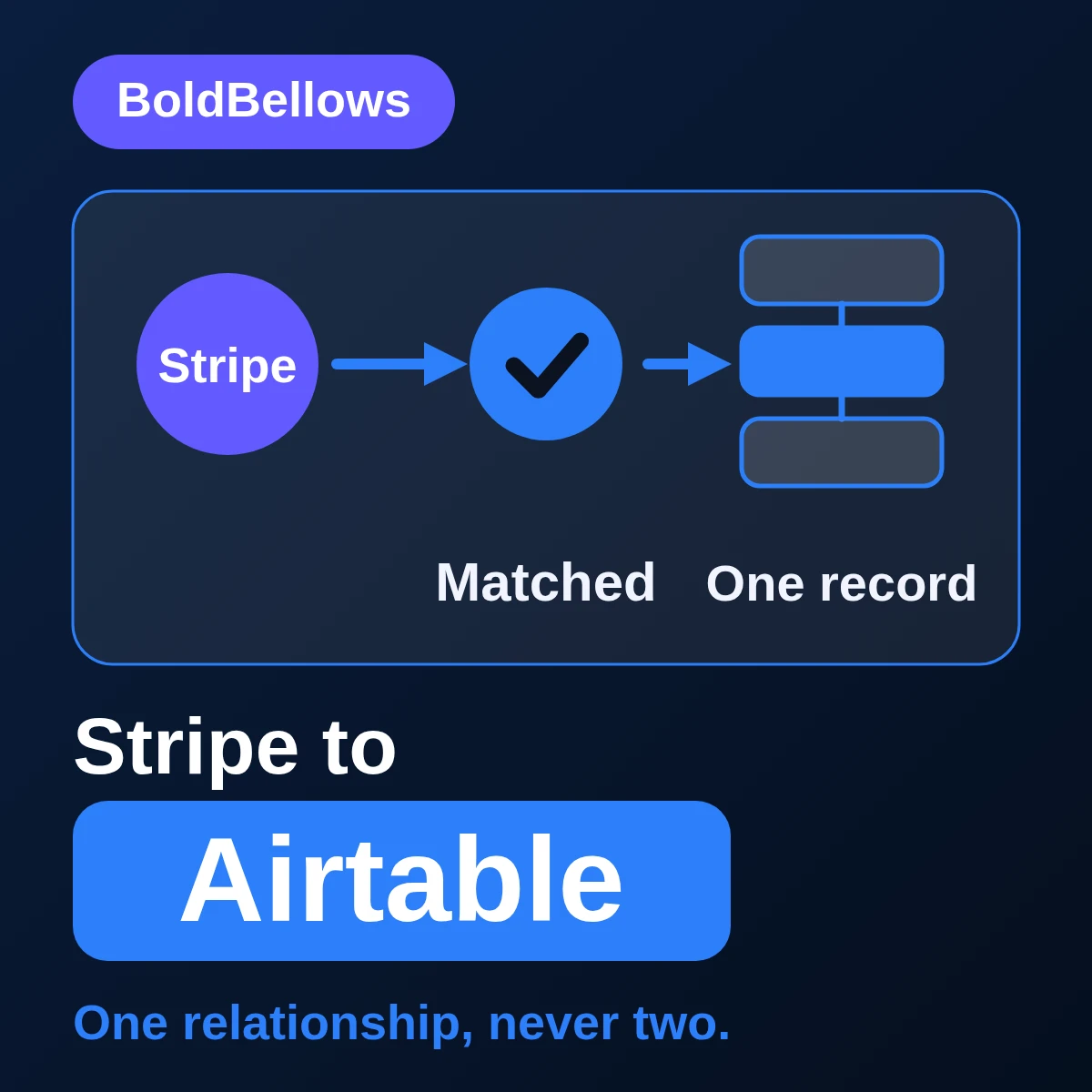
A shallow connector treats every notification as a brand-new row, usually matching on a display name or an email address that was never built to carry identity. It has no way of knowing whether the actor, transaction, and exception records this event needs already exist, so a resend just produces a second, disconnected set. This build resolves through a source identity field plus linked parent IDs first, and only writes once that relationship is genuinely proven absent.
From $395, billed once.
No ongoing sync fee.
01The orphaned-record trap
A shallow connector treats a 200 status as proof that its work is finished. There's no check for whether the actor behind this transaction already sits in another table, no check for whether the same charge got logged an hour earlier under a slightly different name, and no check for whether this write should have updated an existing row instead of creating a fresh one. All three look identical from the response code alone.
Nothing anchored the write to an existing relationship, so a retried webhook built a second, disconnected transaction record.
With identity resting on a mutable label instead of a stable key, one real customer split into two unrelated histories.
Without a stored relationship to search by, the exception sat disconnected from the parent it was meant to explain.
A 200 response from Airtable's API only proves a write was accepted, not that it landed against the correct actor or that a matching relationship didn't already exist somewhere in the base. The source identity field and linked parent IDs are what actually answer that question, rather than piling extra steps onto an otherwise simple create.
The payment activity flowing out of Stripe never has to change for any of this to matter. What's actually at stake is whether one real relationship turns into one linked record set in Airtable, or splits into two, or drifts off into an orphan nobody can trace back to its parent.
Before
After
02How it works
The event is read as an actor, transaction or exception. Its identity is claimed through a source field plus linked parent IDs, the links are checked, and the finished record set is kept as proof for later retries.
03Three tiers, one identity model throughout
Airtable Launch covers identity claiming and a properly linked record set. Route adds qualification branches plus the lookup that tells a genuine update apart from an accidental new create. Govern layers standing drift-watching on top, for bases your team treats as the record of truth rather than a convenience.
LaunchRouteGovern
Claims Stripe account, event ID, object ID, event type and livemode before Airtable ever sees a mutation.
Builds the actor, transaction and exception records with Airtable's own field types and relationships.
Tells a genuine update apart from a webhook that fired the same event a second time.
Steers a dispute or a partial refund toward its own handling logic instead of forcing every object through one path.
Surfaces the week a linked record set and its Stripe source quietly stop agreeing.
04Who it's for
Operations owners who need one accountable route rather than a pile of successful-looking tasks, system administrators who have to defend every scope the route touches, and data stewards for whom a late correction should settle a record, not clone it.
Keeps eligibility, identifiers and failure ownership visible long after the launch celebration wears off.
Can point to a handover that names exactly which objects, fields and permissions the route was ever allowed to touch.
Trusts that a late-arriving correction reconciles the existing linked record set rather than quietly duplicating it.
05Compare
A basic connector reads a Stripe payload and writes a flat row of matching fields, with no concept of the actor, transaction and exception relationship those fields actually describe. Deciding whether a relationship already exists, and what to do when the lookup comes back unclear, is exactly what that speed skips over.
| What decides trust here | Chasing it manually | Off-the-shelf connector | BoldBellows build |
|---|---|---|---|
| What starts the write | Someone happens to spot the change | Every configured event triggers something | YesOnly an event that clears a written admission rule |
| How the match gets decided | Someone searches a name or an email | Trusts whichever field looks unique | YesA source identity field plus linked parent IDs |
| What actually lands | However it got typed in that day | One flat row of copied values | YesA linked actor, transaction and exception set |
| When a match is unclear | Someone cross-checks both screens eventually | Creates the row anyway and moves on | YesSits with a person until the parent is proven |
PricingClear, one-off packages
What separates the three tiers is mostly how many branches your relationships need and whether an ongoing drift check earns its keep for your base. Tell us about the orphaned or duplicated record your team has already untangled by hand, and pricing follows from there. Airtable Launch opens at $395.
View PricingPick a package, answer three short questions about event admission, identity and failure handling, and your price and turnaround move as you choose.
06The process
The base gets read closely before it gets written to. Launch usually lands inside the days quoted because there's exactly one relationship to confirm. Route asks for more calendar time because each added branch needs its own linked-field cases proven out, not a shortcut version of them. Govern earns its longer window for a different reason entirely: a drift signal only means something once real production data has had a chance to disagree with Stripe, and that takes actual weeks, not a rehearsal. If more than one base or legal entity is going to share this route, say so while we're still scoping — it reshapes how identity gets modeled, not just what it costs.
A row your team had to merge, fix or quietly delete tells us more about your real matching problem than a made-up case ever could.
Before any table gets touched, we write down exactly which Stripe value becomes the anchor Airtable will trust for that actor going forward.
Once the identity design holds up under testing, the matcher and record builder switch over to your actual Stripe account and Airtable workspace.
A near-identical name, a resent webhook and a genuinely split relationship all get run on purpose, well before any of them could happen by accident.
Live events start reaching the base while someone on your side still checks the outcomes, and only after that stretch holds up does the route run on its own.
07Security and ownership
The Stripe side of this route only ever reads. The Airtable side only ever writes into the single base you name at the start. Widening either direction takes a deliberate, separately approved change — it never happens by default.
It's issued against one base ID specifically, so even a workspace holding a dozen bases only ever exposes the one this route was built for.
Nothing comes along by default — each value has to be named as part of the actor, transaction or exception record before it's ever pulled from Stripe.
The source identity field and linked parent IDs get checked first, so a record is never built only to discover afterward that it duplicated one already there.
When Airtable's own field or relationship rule turns a write down, the route holds it as a named exception instead of trying the identical write again.
Our logs show which event led to which outcome and why — they were never built to hold a second copy of what's actually sitting in your base.
The field mapping, the identity rule and the exception process all hand over at the end, in enough detail that changing any of them doesn't require calling us first.
08In their words
Verified reviews from operations and finance teams who trust BoldBellows to keep one relationship from ever becoming two disconnected records.
AI Video & Voice Automation
We publish product videos every week, and BoldBellows introduced us to AI video automation. The system writes the script, voices it and produces the finished video in minutes.
The quality is remarkable: professional voiceovers, clean visuals and smooth editing. Production time went from three days to under 30 minutes, and we scaled our video marketing without adding cost.
AI E-commerce Listings Automation
BoldBellows automated our product listings. The AI writes descriptions, organizes photos and publishes listings across several marketplaces.
It even answers customer questions instantly. Our store looks more professional and sales have noticeably increased.
AI Chatbot & Customer Support
BoldBellows built an AI support chatbot for our online boutique, and it has changed how we run the business. We used to have two full-time staff answering the same questions all day. Now the AI handles order tracking, product recommendations and even refund requests on its own.
What surprised me most is how natural it sounds. Customers compliment the ‘agent’ without realizing it’s AI. Our support workload dropped by 75% and customer satisfaction went up dramatically.
AI Translation & Localisation
When we expanded abroad we needed fast, accurate translations. BoldBellows built an AI translation system that turns our content into several languages instantly.
The translations read naturally and suit each culture. We now serve customers in five new countries without hiring translators. BoldBellows helped us go global.
AI Social Comment & DM Automation
We get thousands of comments and messages every week. BoldBellows built an AI system that replies instantly, filters spam and surfaces the important ones.
Engagement is up and our page looks active around the clock. It’s like having a full social media team that never stops.
AI Workflow Automation for Agencies
Running a digital agency with many clients was overwhelming. BoldBellows built one automation dashboard that tracks tasks, sends updates and creates client reports automatically.
Clients love the transparency and we love the time we get back. Productivity is up, and project delays have dropped to almost zero.
AI Accounting & Invoice Automation
BoldBellows automated our whole invoicing process: creating invoices, sending reminders and tracking payments.
Late payments dropped sharply, and our accounting team finally has time for strategy instead of repetitive admin. Worth every penny.
AI Content & Social Media Automation
Our marketing agency couldn’t keep up with content. BoldBellows set up an AI content engine that writes blog posts and captions and even designs our social media creatives.
It spots trends and suggests topics for us, so we stay ahead of competitors. We now produce three times the content with the same team, and engagement has soared. They didn’t just automate our workflow, they lifted our whole brand.
AI Customer Journey Automation
We wanted a smoother path from first contact to purchase. BoldBellows built an AI system that guides each customer there automatically.
It sends personalized messages, recommends products and follows up at just the right moment. Customer retention has improved dramatically.
AI Lead Qualification & Sales Automation
Our sales team wasted hours chasing cold leads. BoldBellows built an AI lead-scoring system that reads behavior, email engagement and buying signals.
It filters out weak leads and sends personalized follow-ups automatically, so our team only talks to people who are ready to buy. Conversions rose 40% in the first month. It paid for itself straight away.
AI Email & Smart Inbox Management
Our inbox used to be chaos. BoldBellows built an AI email system that sorts messages, drafts replies and flags anything urgent.
It learns how we write and gets better every week. We reply faster and no longer miss important messages. It feels like having a personal assistant working around the clock.
AI Booking & Scheduling Automation
Our coaching business needed a better way to schedule. BoldBellows automated all of it: bookings, reminders, cancellations and follow-ups.
No-shows fell by 60% and clients enjoy how smooth it is. It feels personal, not robotic. One of the best upgrades we’ve made.
AI HR & Recruitment Automation
Our HR team was drowning in applications. BoldBellows automated screening, skills-based filtering and interview scheduling.
It saves us hours every week and means we only interview qualified people. Hiring is now faster, better organized and more professional.
AI Data Entry & Reporting Automation
We used to spend hours collecting data and building weekly reports by hand. BoldBellows automated all of it.
The reports are clean, visual and easy to read, and our managers rely on them for quick decisions. Human error is gone and our numbers are more accurate across the board.
AI Document & Contract Automation
Onboarding was slow because we wrote every contract by hand. BoldBellows automated the lot: contracts, welcome emails and client setup.
What took 48 hours now takes under 10 minutes, and clients regularly tell us how professional it feels.
AI CRM Automation
Our CRM was barely used because updating it by hand was tedious. BoldBellows automated data entry, tagging, segmentation and follow-ups.
Now the CRM is always up to date and our campaigns are far more accurate. It improved our whole sales pipeline.
AI Voice Assistant
BoldBellows built a custom AI voice assistant for our customer hotline. It answers questions, books appointments and handles simple requests.
Customers love how fast it is, and our call-centre workload dropped dramatically. One of the smartest upgrades we’ve made.
AI Automation Partner
BoldBellows is hands-down the best AI automation partner we’ve worked with. Their systems are fast, reliable and built around how our business actually works.
Every automation they’ve delivered, from customer service to content, runs flawlessly. We’ve saved time, cut costs and grown faster than we expected.
09FAQ
Have a relationship in your own base that seems like it wouldn't resolve cleanly? Describe the shape of it and we'll walk through exactly how the matcher would treat it.
A recipe can catch the webhook without any trouble. What it has no way to do is check whether the actor on the other end already has a linked record, or decide what happens when that lookup turns up two candidates instead of one — and that decision tree is the entire reason this exists.
Never directly. Everything runs through documented APIs, webhooks and Airtable's own permission model. If a setting on either side genuinely needs changing for this to work, it's called out by name in the handover rather than assumed.
On Route and Govern, yes, inside a bounded window. The import runs through the identical identity check as live traffic, so a relationship already sitting in the base never gets written a second time.
Nothing about what Stripe or Airtable bill you separately changes. This price only covers the design, the build and the testing behind it, and it's paid one time.
The handover names every object and field this build leans on. If one of them moves, the write that depends on it pauses and gets flagged rather than guessing, and correcting for the change becomes its own scoped piece of work once your review period ends.
Not usually, provided we hear about the shape during mapping rather than discovering it after launch. A pattern with one clear answer becomes a rule inside the matcher; anything genuinely undecidable gets set aside for a person rather than resolved by a guess. If you searched for stripe to airtable, sync stripe payments to airtable and stripe airtable integration, this is the service that delivers it.
Next stepStop untangling duplicate base records
Bring one real Stripe event, the linked record it should produce, and the orphaned or duplicated row your team has already had to fix by hand — we'll scope the build from there. Airtable Launch starts at $395.