A reply with an invented price
The draft quoted a figure no one had agreed.
Gmail AI inbox triage with a person in charge
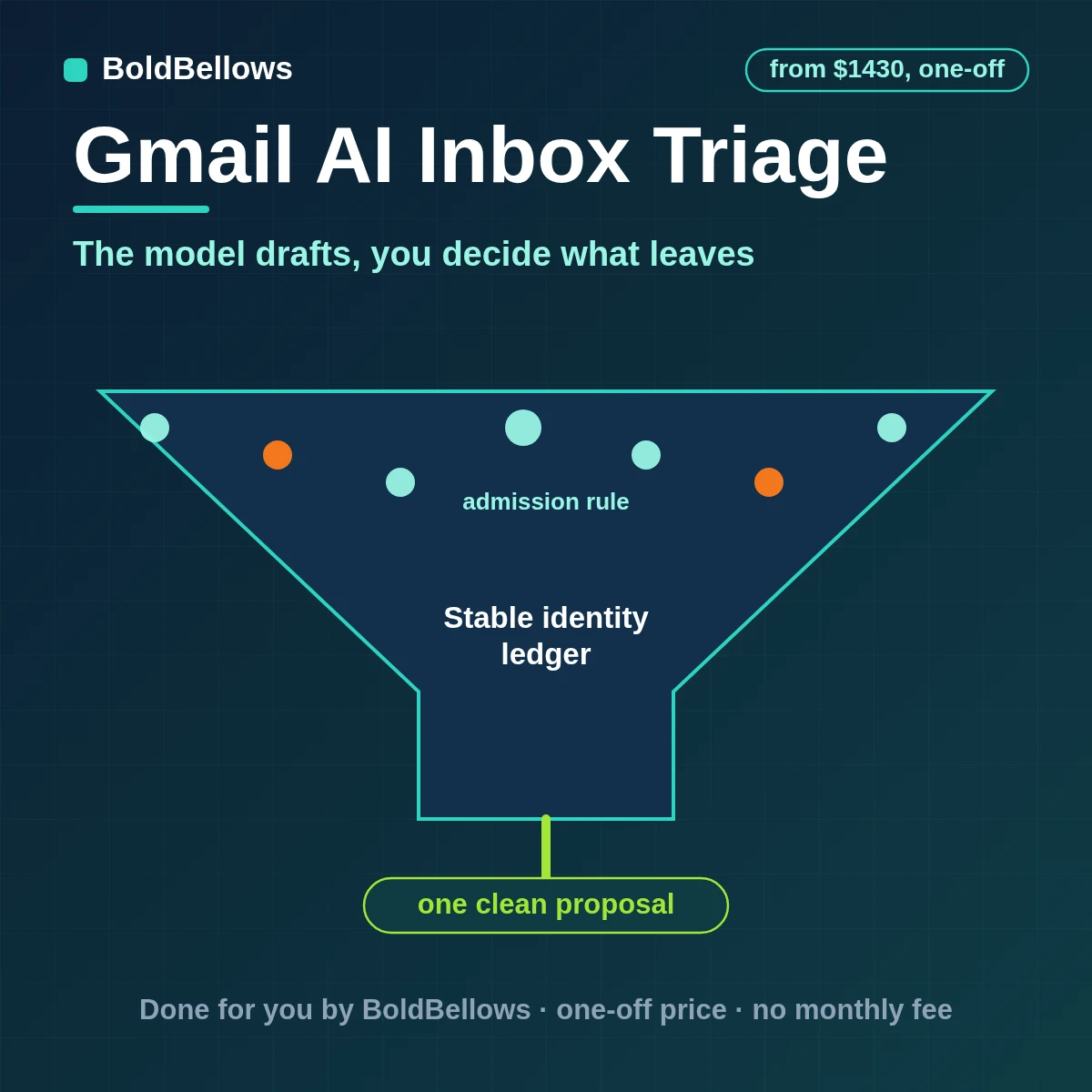
Gmail AI inbox triage lets a model read the messages that qualify and suggest what to do, without ever holding the send button. A Gmail push names no message, only a history ID, and a stranger's email can carry instructions meant for the model. BoldBellows notes which label the message carries, which thread it belongs to and when it arrived, gives a late notification time to land and checks the order before it writes, then passes the model only the fields you approve as quoted data, validates its structured answer and files a proposal with its evidence for a person to accept, edit or refuse.
From $1,430, paid once. Triage Gmail with AI and keep control.
B2Before and after
Give a model a mailbox and it will soon reply to a supplier with a price it invented, file a complaint under newsletters, or follow an instruction hidden in an email it was only meant to read. A thread has fifty messages and the summary drops the one that changed the deal. Gmail drops notifications beyond one a second, so some mail is never seen, and nobody can say what the model read or which prompt was running.
Sound familiar?
The draft quoted a figure no one had agreed.
The label was wrong and the message sat unread.
A message told the model what to do and it complied.
Fifty messages became one paragraph without the key line.
A burst of notifications was dropped and nothing re-read the history.
On this Gmail AI Inbox Triage service, nobody could say what the model saw or how sure it was.
Before
After
D4How it works
A change is admitted, identified, matched and written, always in that order.
The notification is authenticated, stamped with account, resource and time, then checked against the admission rule.
The history since the last ID is read, each new message is tested against your rule and its authentication headers, and only approved fields are prepared as quoted data.
The model's structured answer is validated, held with its evidence, confidence and policy version, and a label or a sent reply happens only after the approval you require.
E5Inside your workflow
Foundation sets the rules and the key. Operations does the writing. Assurance compares both sides over time.
Foundation
Decides which Gmail events may proceed and logs why the others were set aside.
Foundation
Keeps one record per Gmail signal with its inputs, its evidence, its confidence and who accepted it.
Foundation
Maps approved Gmail fields to the AI workflow fields one by one and rejects anything not on the list.
Operations
Tests each message against your rule, its sender and its authentication results before anything reaches a model.
Operations
Decides between create, update and leave alone by reading a decision key made of the message ID, the thread ID, the model-run ID and the policy version.
Operations
Decides, by sender type and confidence, whether a proposal is shown, auto-labelled or sent to a reviewer.
Assurance
Lines up Gmail and the AI workflow on a schedule and lists what no longer agrees.
Assurance
Flags a changed prompt, model version or policy before the triage quietly changes.
Assurance
Gives each unresolved Gmail case a named owner, so nothing waits in a shared inbox.
If Gmail ai automation duplicate prevention is the goal, Gmail ai inbox triage and Gmail AI integration are included in the scope. Related searches include Gmail ai inbox triage automation service, Gmail ai automation historical migration, Gmail ai inbox triage automation, Gmail ai automation implementation, AI workflow for Gmail, Gmail ai automation error handling, Gmail AI assistant, Gmail AI consulting, governed ai for Gmail, ai email triage for Gmail, summarise Gmail threads with ai, Gmail ai human approval, Gmail ai draft replies, Gmail ai automation consultant, Gmail intelligent workflow, label Gmail automatically with ai and Gmail AI automation.
G7Who it is for
Gmail holds the conversation; a model can help read it, as long as a person decides what leaves.
"I want help clearing the inbox, not a bot answering for me."
The model drafts and labels, and you decide what is sent.
"Know what the model read."
On this Gmail AI Inbox Triage service, only the approved fields reach the model, and every request is recorded.
"Keep customer replies accurate."
Drafts quote only facts from the approved sources, with the evidence beside them.
"Stop a message steering the model."
The body is wrapped as data inside fixed instructions, and a reply that does not fit the schema is thrown out.
"Each client has rules."
Policies and approvers are set per mailbox, so nothing crosses clients.
"I triage for my boss."
Labels and drafts wait in the mailbox for a quick review.
What drives the cost: proposals, approvals and policies
The total moves with every choice you make about the Gmail AI route. Entry pricing is $1,430.
One setup fee
I9Your options
Each can ask a model.
| How a run starts | An AI reply add-on | A generic AI zap for Gmail | Our evidence-gated triage route |
|---|---|---|---|
| What starts the work | A person spots the update | Every matching hook runs | Only a mailbox event that meets the written rule |
| How identity is decided | Whoever it is checks the name | Email or name, compared as typed | A decision key: message, thread, model run and policy |
| What reaches the AI workflow | Fields typed from memory | Every mapped field, as plain text | A validated proposal with its evidence, confidence and approval state |
| After an uncertain result | Someone checks by eye | Retry, or give up | Searches by a decision key made of the message ID, the thread ID, the model-run ID and the policy version, compares, then repairs |
The timestamp on the incoming Gmail event is checked first; a stale one is recorded and closed instead of rolling the proposal back.
The proposal is rejected and logged with the reason, nothing is labelled or drafted, and the message goes to a person. The route looks for the proposal through a decision key made of the message ID, the thread ID, the model-run ID and the policy version, compares it with the intended values and records a verdict: absent, correct, different or unclear.
Start the Gmail to the AI workflow build with a decision key made of the message ID, the thread ID, the model-run ID and the policy version; the rest of the route leans on it.
Pick a package, answer three short questions about how Gmail data should reach AI Inbox Triage, and your price and turnaround move as you choose.
J11The process
From the first brief to the first month live, six steps with clear outputs.
We agree which messages the model may see, what it may propose, such as a label, a summary or a draft, and who approves each kind.
Read access to the Gmail data in scope is arranged, the model connection is chosen and the approval path is drawn up.
The Gmail fields the model sees, the policy for each proposal type and the approver for each are written down and signed off.
For Gmail AI Inbox Triage, we replay events, delay them, remove fields and revoke access in a safe the AI workflow copy before anything goes live.
The last step is release: a defined start, a review window and a PDF you can keep.
Once real events flow, the opening weeks are checked against the evidence log so early surprises are caught and recorded.
K12Turnaround
Delivery time starts once access to Gmail and the model service is confirmed.
6 to 10 business days
10 to 16 business days
16 to 24 business days
L13Getting started
M14Safety and ownership
We read the Gmail data in scope, withhold the rest, and record every suggestion and every decision about it.
The route talks to Gmail and the AI workflow only through documented endpoints, so neither needs a plugin, a patch or a hidden setting.
Permissions are written down, minimal and reversible.
A written field map decides what crosses. Anything not on it, including private notes and billing data, is left behind.
After any uncertain result the route looks for the proposal using a decision key made of the message ID, the thread ID, the model-run ID and the policy version; only a proven absence allows a new one.
Evidence of a run is kept as references, not as copies of data.
The PDF names each rule, credential and owner so your admins are never guessing.
N15In their words
Verified reviews from business owners who use BoldBellows automations every day, from marketing and sales to support and operations.
AI Email & Smart Inbox Management
Our inbox used to be chaos. BoldBellows built an AI email system that sorts messages, drafts replies and flags anything urgent.
It learns how we write and gets better every week. We reply faster and no longer miss important messages. It feels like having a personal assistant working around the clock.
AI Workflow Automation for Agencies
Running a digital agency with many clients was overwhelming. BoldBellows built one automation dashboard that tracks tasks, sends updates and creates client reports automatically.
Clients love the transparency and we love the time we get back. Productivity is up, and project delays have dropped to almost zero.
AI HR & Recruitment Automation
Our HR team was drowning in applications. BoldBellows automated screening, skills-based filtering and interview scheduling.
It saves us hours every week and means we only interview qualified people. Hiring is now faster, better organized and more professional.
AI Accounting & Invoice Automation
BoldBellows automated our whole invoicing process: creating invoices, sending reminders and tracking payments.
Late payments dropped sharply, and our accounting team finally has time for strategy instead of repetitive admin. Worth every penny.
AI Data Entry & Reporting Automation
We used to spend hours collecting data and building weekly reports by hand. BoldBellows automated all of it.
The reports are clean, visual and easy to read, and our managers rely on them for quick decisions. Human error is gone and our numbers are more accurate across the board.
AI E-commerce Listings Automation
BoldBellows automated our product listings. The AI writes descriptions, organizes photos and publishes listings across several marketplaces.
It even answers customer questions instantly. Our store looks more professional and sales have noticeably increased.
AI Customer Journey Automation
We wanted a smoother path from first contact to purchase. BoldBellows built an AI system that guides each customer there automatically.
It sends personalized messages, recommends products and follows up at just the right moment. Customer retention has improved dramatically.
AI Document & Contract Automation
Onboarding was slow because we wrote every contract by hand. BoldBellows automated the lot: contracts, welcome emails and client setup.
What took 48 hours now takes under 10 minutes, and clients regularly tell us how professional it feels.
AI Social Comment & DM Automation
We get thousands of comments and messages every week. BoldBellows built an AI system that replies instantly, filters spam and surfaces the important ones.
Engagement is up and our page looks active around the clock. It’s like having a full social media team that never stops.
AI Chatbot & Customer Support
BoldBellows built an AI support chatbot for our online boutique, and it has changed how we run the business. We used to have two full-time staff answering the same questions all day. Now the AI handles order tracking, product recommendations and even refund requests on its own.
What surprised me most is how natural it sounds. Customers compliment the ‘agent’ without realizing it’s AI. Our support workload dropped by 75% and customer satisfaction went up dramatically.
AI Content & Social Media Automation
Our marketing agency couldn’t keep up with content. BoldBellows set up an AI content engine that writes blog posts and captions and even designs our social media creatives.
It spots trends and suggests topics for us, so we stay ahead of competitors. We now produce three times the content with the same team, and engagement has soared. They didn’t just automate our workflow, they lifted our whole brand.
AI Lead Qualification & Sales Automation
Our sales team wasted hours chasing cold leads. BoldBellows built an AI lead-scoring system that reads behavior, email engagement and buying signals.
It filters out weak leads and sends personalized follow-ups automatically, so our team only talks to people who are ready to buy. Conversions rose 40% in the first month. It paid for itself straight away.
AI Video & Voice Automation
We publish product videos every week, and BoldBellows introduced us to AI video automation. The system writes the script, voices it and produces the finished video in minutes.
The quality is remarkable: professional voiceovers, clean visuals and smooth editing. Production time went from three days to under 30 minutes, and we scaled our video marketing without adding cost.
AI Booking & Scheduling Automation
Our coaching business needed a better way to schedule. BoldBellows automated all of it: bookings, reminders, cancellations and follow-ups.
No-shows fell by 60% and clients enjoy how smooth it is. It feels personal, not robotic. One of the best upgrades we’ve made.
AI Translation & Localisation
When we expanded abroad we needed fast, accurate translations. BoldBellows built an AI translation system that turns our content into several languages instantly.
The translations read naturally and suit each culture. We now serve customers in five new countries without hiring translators. BoldBellows helped us go global.
AI CRM Automation
Our CRM was barely used because updating it by hand was tedious. BoldBellows automated data entry, tagging, segmentation and follow-ups.
Now the CRM is always up to date and our campaigns are far more accurate. It improved our whole sales pipeline.
AI Voice Assistant
BoldBellows built a custom AI voice assistant for our customer hotline. It answers questions, books appointments and handles simple requests.
Customers love how fast it is, and our call-centre workload dropped dramatically. One of the smartest upgrades we’ve made.
AI Automation Partner
BoldBellows is hands-down the best AI automation partner we’ve worked with. Their systems are fast, reliable and built around how our business actually works.
Every automation they’ve delivered, from customer service to content, runs flawlessly. We’ve saved time, cut costs and grown faster than we expected.
P16FAQ
We collected the questions that decide most purchases and answered them.
When a suggested reply to every message is all that is wanted, a connector can manage that. It cannot check which messages qualify, validate the model's structured answer and leave sending to a person. Those gaps are the reason this build exists.
No. The model only returns a proposal. Sending, labelling and filing wait for the approval step you choose, and a draft stays a draft until a person releases it.
Only the fields on an approved list, such as sender, subject and the plain-text body, passed as quoted data. Attachments and anything else stay out unless you add them.
The body is never treated as instructions.
No. Gmail allows one notification a second and drops the rest, so the route reads the whole history since its last ID every time and falls back to a full sync if Gmail answers 404.
On this Gmail AI Inbox Triage service, the route works with the model service you approve.
Scopes are the narrowest that do the job, requests carry as little as the task needs, and what the provider retains depends on the plan we agree and document with you.
Yes. We list every Gmail field the model may read and every field a proposal may write, with a reason beside each.
Yes. A custom Gmail AI route can branch by type, owner or confidence and ask for approval only where you want it, from $1,430.
The handover lists every interface the route uses. If one changes, the affected item stops and is flagged instead of being written from a guess. Repairs after your review window are quoted separately. If you searched for automate gmail with AI and custom gmail AI automation, this is the service that delivers it.
Q17Clear the inbox faster, and keep the send button
Tell us which Gmail items should reach the model and who signs off. The price comes before anything else, from $1,430.
Unusual volumes or extra systems are quoted on request.