A card the instant an FBM order lands
No waiting for someone to notice it and make one by hand.
FBM Fulfillment Board +Amazon Seller Trello board
Every FBM order carries a real ship-by date in Seller Central, and missing it hits your Late Shipment Rate, not just a to-do list. We create a card per FBM order with that exact deadline attached, moving through a pipeline built around how your team actually packs and ships.
From $250, paid once. No per-seat automation bill.
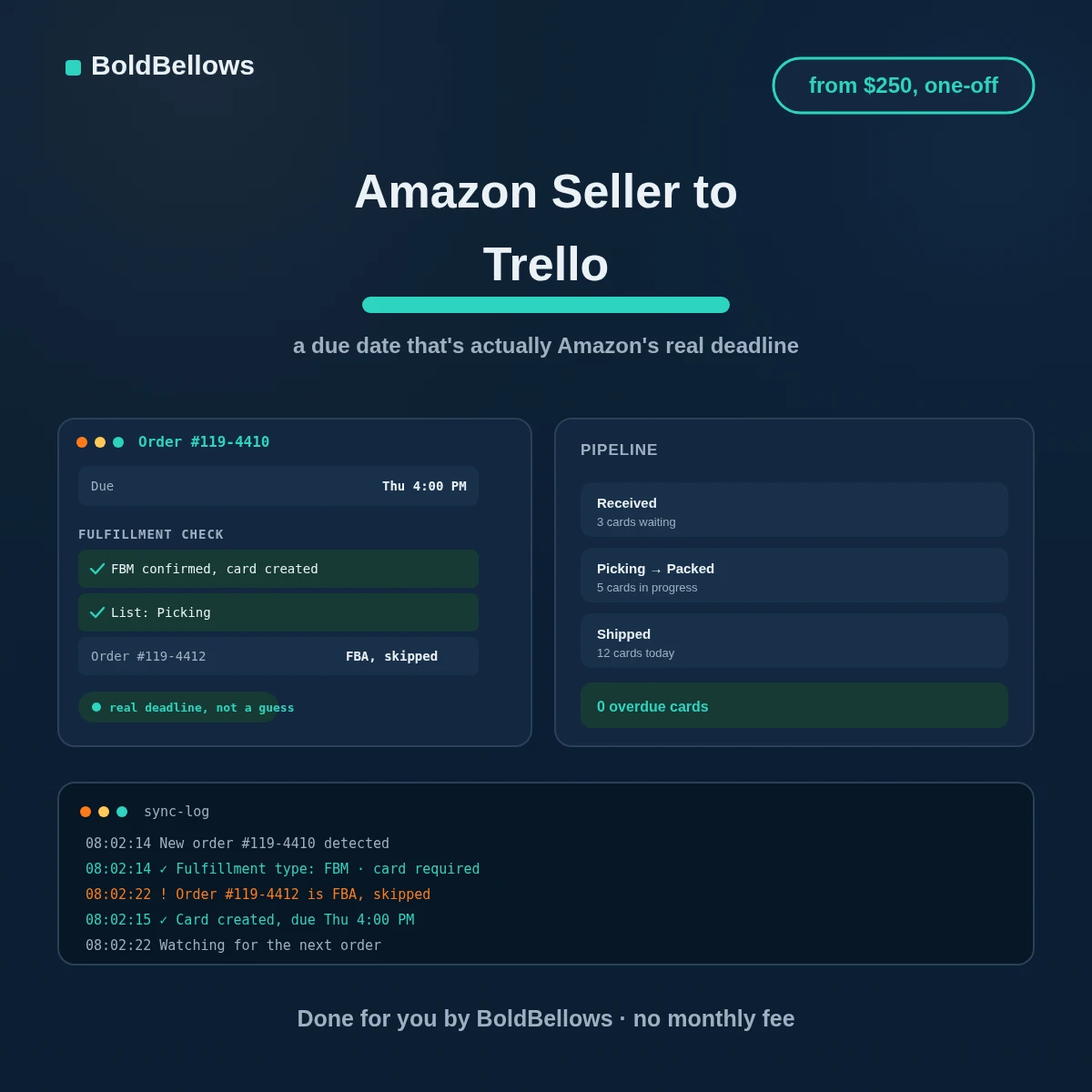
01 · the deadline most boards ignore
A card someone creates by hand carries whatever due date they guessed at. Amazon's own ship-by deadline is a specific, tracked number, and missing it repeatedly is exactly what pushes Late Shipment Rate into risk territory.
02 · how it works
One credential, scoped to your account, watches two fields on every incoming order: how it's fulfilled and when it's due. A card exists only for the merchant-fulfilled half, and its deadline is never invented.
Your Seller Central credential and our board access get set up back to back, with someone guiding you through each step live.
Lists, card fields and overdue handling all take shape around how your team actually packs and ships.
A handful of actual FBM orders create cards before you see the board live, so the deadlines already check out.
03 · what a card actually carries
Whoever's packing gets everything they need on the card in front of them, not a separate tab open to Seller Central just to check a deadline.
A single card: which list it's in, what's inside the order, and exactly when it has to ship.
No waiting for someone to notice it and make one by hand.
FBM Fulfillment Board +Set from Amazon's own deadline, not a guess.
Ship-By Deadline Tracking +Received, picking, packed, shipped, ready from day one.
Ship-By Deadline Tracking +Matched to the steps you actually follow, not a generic template.
Full Ops BoardSomeone gets pinged, not just a red badge nobody notices.
Full Ops BoardAttached automatically, ready to tick off as you go.
Extra04 · who it's for
Each role below is watching the same clock from a different angle. This puts the real number in front of all of them.
"Our Late Shipment Rate crept up before we noticed why."
Now a slipping card is visible days before it ever becomes a real mark.
"I'm never sure which orders are actually most urgent."
Due dates on the board sort that out without anyone having to ask.
"By the time I notice a card's stuck, it's already late."
Escalation catches it before that point, not after.
"FBA orders keep cluttering up boards meant for what we actually pack."
The board only ever sees the orders that need it.
Priced by how much each card carries
FBM Fulfillment Board, Ship-By Deadline Tracking or Full Ops Board as your base, then how many stages and how overdue cards get flagged. From $250, one payment.
05 · compare your options
Two of these get an order tracked somehow. Only one of them ties that tracking to the actual deadline Amazon is measuring.
| What decides it | Hand-made cards | Zapier or Make | BoldBellows |
|---|---|---|---|
| Due date matches Amazon's real deadline | Guessed, whatever someone typed in | Possible, with a mapping you'd build yourself | Pulled straight from the real order |
| Skips FBA orders automatically | Depends who's making the cards that day | Something you'd have to wire up separately | Part of how the first card ever gets made |
| Effort on a busy shipping day | Costs nothing, eats into packing time | Task usage climbs right with your order count | Paid once, from $250, done |
| Who maintains the board | You, card by card | Locked inside whoever set it up | Spelled out, and yours going forward |
A buyer cancellation after the card exists could leave a stale card sitting on the board, confusing whoever's packing that day.
We build a cancellation check into the sync, so a cancelled order's card gets archived automatically instead of lingering.
Adding a second board nobody checks is worse than useless, since it just becomes another thing to remember.
We can build the lists directly into an existing board instead, so this fits into the workflow you already run.
Pick a package, answer three short questions about what each card should carry, how many pipeline stages you need, and how overdue cards should get flagged, and your price and go-live date move as you choose.
06 · process & getting started
Getting from a workflow conversation to cards moving themselves runs through five stages, and we carry nearly all of it. You describe how packing actually happens, connect two accounts, and check cards built from real orders before it goes live.
What stages an order actually passes through, and who's responsible for moving a card at each one.
You'll issue the Seller Central credential live on the call, and we'll pick up board access right after, no separate scheduling needed.
Pipeline stages, due-date logic and the rule that separates FBM from FBA come together around the workflow we sketched in step one.
A handful of actual FBM orders create cards before the board goes live, so we catch anything off before you would.
A short guide covers every list and rule we built, and new cards keep appearing without us in the loop.
The clock on this starts once we've got what we need from both sides. Paying up for the faster tier is the one thing that actually bumps the date.
Standard Seller Central admin access covers this; we'll point you to the right screen.
An invite as admin is plenty for us to set up the board and automation.
Even an informal description is enough to design the pipeline around.
We can build fresh, or add lists into what you're already running.
07 · security and ownership
Your catalog operates precisely as it did the day before this went live. The one thing it's given is enough visibility into an order to turn it into a card.
Changing a price or editing a listing simply isn't something this credential can do.
Moving a card and marking Amazon's own order as shipped stay two separate steps, deliberately.
Whatever workspace we settled on together is the only place a new card ever shows up.
Pull either credential and the board simply stops receiving new ones, with everything already there left untouched.
We look at it just long enough to build the card, then move straight on to the next one.
There's no license attached to any of it. It's simply how your workspace is set up from here on.
08 · verified reviews
Verified reviews from business owners who use BoldBellows automations every day, across operations, support, sales and reporting, in the Amazon Seller to Trello route.
AI Accounting & Invoice Automation
BoldBellows automated our whole invoicing process: creating invoices, sending reminders and tracking payments.
Late payments dropped sharply, and our accounting team finally has time for strategy instead of repetitive admin. Worth every penny.
AI Video & Voice Automation
We publish product videos every week, and BoldBellows introduced us to AI video automation. The system writes the script, voices it and produces the finished video in minutes.
The quality is remarkable: professional voiceovers, clean visuals and smooth editing. Production time went from three days to under 30 minutes, and we scaled our video marketing without adding cost.
AI Customer Journey Automation
We wanted a smoother path from first contact to purchase. BoldBellows built an AI system that guides each customer there automatically.
It sends personalized messages, recommends products and follows up at just the right moment. Customer retention has improved dramatically.
AI Booking & Scheduling Automation
Our coaching business needed a better way to schedule. BoldBellows automated all of it: bookings, reminders, cancellations and follow-ups.
No-shows fell by 60% and clients enjoy how smooth it is. It feels personal, not robotic. One of the best upgrades we’ve made.
AI Chatbot & Customer Support
BoldBellows built an AI support chatbot for our online boutique, and it has changed how we run the business. We used to have two full-time staff answering the same questions all day. Now the AI handles order tracking, product recommendations and even refund requests on its own.
What surprised me most is how natural it sounds. Customers compliment the ‘agent’ without realizing it’s AI. Our support workload dropped by 75% and customer satisfaction went up dramatically.
AI Social Comment & DM Automation
We get thousands of comments and messages every week. BoldBellows built an AI system that replies instantly, filters spam and surfaces the important ones.
Engagement is up and our page looks active around the clock. It’s like having a full social media team that never stops.
AI HR & Recruitment Automation
Our HR team was drowning in applications. BoldBellows automated screening, skills-based filtering and interview scheduling.
It saves us hours every week and means we only interview qualified people. Hiring is now faster, better organized and more professional.
AI Content & Social Media Automation
Our marketing agency couldn’t keep up with content. BoldBellows set up an AI content engine that writes blog posts and captions and even designs our social media creatives.
It spots trends and suggests topics for us, so we stay ahead of competitors. We now produce three times the content with the same team, and engagement has soared. They didn’t just automate our workflow, they lifted our whole brand.
AI E-commerce Listings Automation
BoldBellows automated our product listings. The AI writes descriptions, organizes photos and publishes listings across several marketplaces.
It even answers customer questions instantly. Our store looks more professional and sales have noticeably increased.
AI Lead Qualification & Sales Automation
Our sales team wasted hours chasing cold leads. BoldBellows built an AI lead-scoring system that reads behavior, email engagement and buying signals.
It filters out weak leads and sends personalized follow-ups automatically, so our team only talks to people who are ready to buy. Conversions rose 40% in the first month. It paid for itself straight away.
AI Email & Smart Inbox Management
Our inbox used to be chaos. BoldBellows built an AI email system that sorts messages, drafts replies and flags anything urgent.
It learns how we write and gets better every week. We reply faster and no longer miss important messages. It feels like having a personal assistant working around the clock.
AI Workflow Automation for Agencies
Running a digital agency with many clients was overwhelming. BoldBellows built one automation dashboard that tracks tasks, sends updates and creates client reports automatically.
Clients love the transparency and we love the time we get back. Productivity is up, and project delays have dropped to almost zero.
AI Translation & Localisation
When we expanded abroad we needed fast, accurate translations. BoldBellows built an AI translation system that turns our content into several languages instantly.
The translations read naturally and suit each culture. We now serve customers in five new countries without hiring translators. BoldBellows helped us go global.
AI Data Entry & Reporting Automation
We used to spend hours collecting data and building weekly reports by hand. BoldBellows automated all of it.
The reports are clean, visual and easy to read, and our managers rely on them for quick decisions. Human error is gone and our numbers are more accurate across the board.
AI Document & Contract Automation
Onboarding was slow because we wrote every contract by hand. BoldBellows automated the lot: contracts, welcome emails and client setup.
What took 48 hours now takes under 10 minutes, and clients regularly tell us how professional it feels.
AI CRM Automation
Our CRM was barely used because updating it by hand was tedious. BoldBellows automated data entry, tagging, segmentation and follow-ups.
Now the CRM is always up to date and our campaigns are far more accurate. It improved our whole sales pipeline.
AI Voice Assistant
BoldBellows built a custom AI voice assistant for our customer hotline. It answers questions, books appointments and handles simple requests.
Customers love how fast it is, and our call-centre workload dropped dramatically. One of the smartest upgrades we’ve made.
AI Automation Partner
BoldBellows is hands-down the best AI automation partner we’ve worked with. Their systems are fast, reliable and built around how our business actually works.
Every automation they’ve delivered, from customer service to content, runs flawlessly. We’ve saved time, cut costs and grown faster than we expected.
09 · questions
These questions kept coming up on real calls before past builds ever went live. If your packing floor works differently, that conversation belongs in a quote request instead.
No, and that's deliberate. This is read-only against Amazon, so marking an order shipped stays a step you take in Seller Central or your shipping tool, same as always.
The sync checks for cancellations and archives the card automatically, so nobody's packing an order that no longer exists.
Yes. We can add the lists and automation directly into a board you already run, rather than asking your team to start checking somewhere new.
Making a plain card from a trigger, sure. Knowing which orders are actually yours to pack, or pulling the correct date off an Amazon order, sits outside what it does natively, so someone still has to design that part, and pay per card while doing it. That's the part we treat as the real work.
The multi-board extra covers a second warehouse or marketplace with its own board, or it moves to a custom quote for anything wider than that.
A card carries exactly what packing requires and no more, and you're paying for the build once, not renting access to it month after month.
Cards simply stop appearing when something upstream breaks, and that's usually noticeable within a day or so. Aftercare means we're the ones who fix it inside the following 90 days, not you.
Stop finding out about a late shipment after it's late
Work out your number in the builder below, or describe a second warehouse, a returns pipeline running alongside fulfillment, or a stage structure these three packages skip. Starts at $250, one payment, no monthly line item to track afterward.
Got a packing process none of these three quite match? Walk us through it and we'll come back with a price for the board you actually run. If you searched for amazon seller orders to trello card, amazon seller trello integration and amazon seller trello task creation, this is the service that delivers it.