An unsubscribe undone
A late retry re-marked a contact as subscribed.
GetResponse to Airtable automation for a subscriber base that stays in order
GetResponse to Airtable automation turns GetResponse's webhook stream into a base your marketing team can query. GetResponse expects a reply within five seconds and retries three more times, and one request may carry as many as 100 events. BoldBellows files the webhook ID with the contact ID as the replay key, lets the whole batch arrive before it writes anything, then finds or creates the campaign and contact, writes the event as a linked record and uses the occurred-at time so an old event never overwrites a new one.
From $520, paid once. Sync GetResponse contacts to Airtable without duplicates.
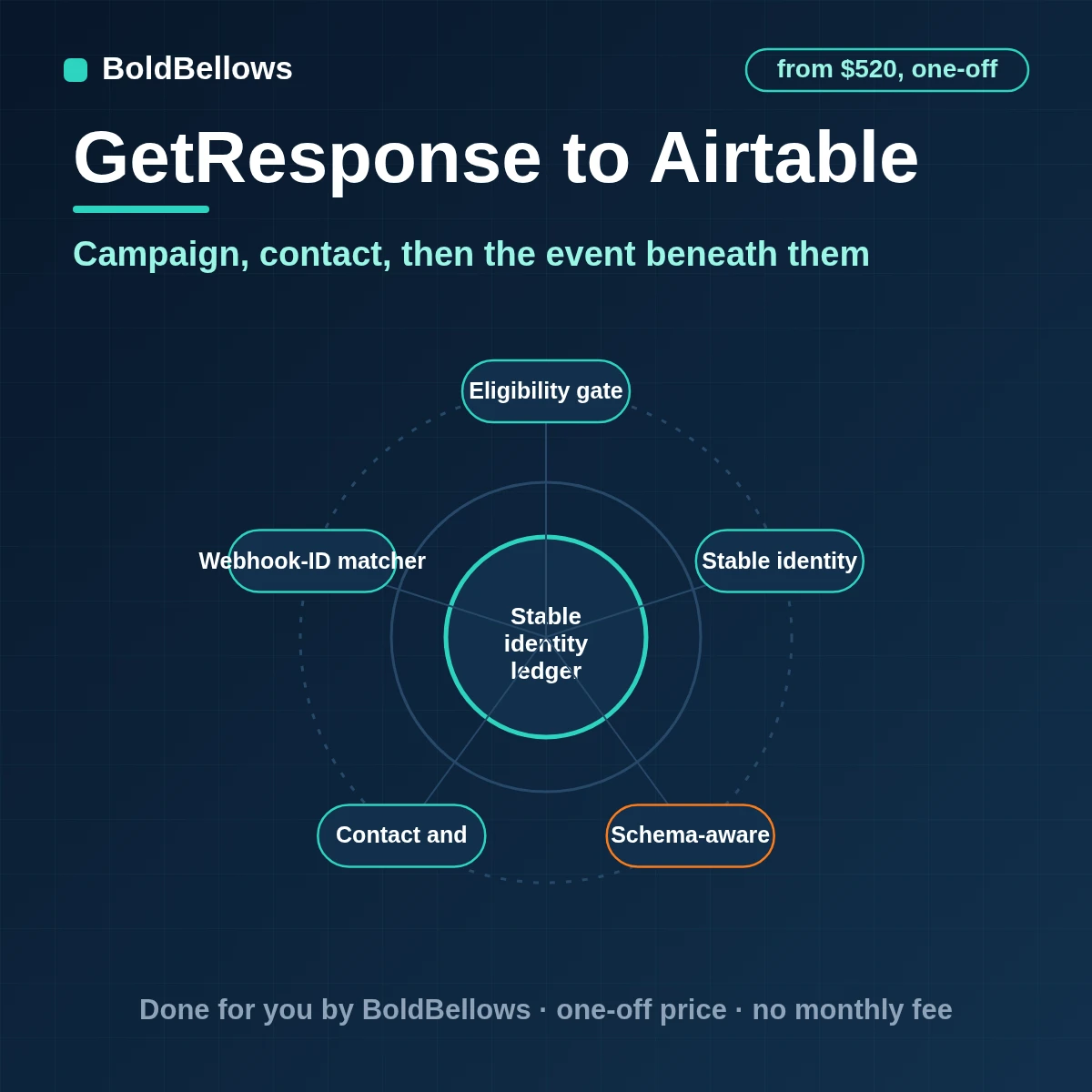
01 · the out-of-order problem
GetResponse can retry an event three more times and can deliver a batch of up to 100 at once. Write rows as they land and a contact who unsubscribed this morning is shown as subscribed again by a late retry. Add a move between campaigns and an email change, and nobody can say who is on which list.
A late retry re-marked a contact as subscribed.
Moves, copies and an email change each created a new line for the same contact.
The event arrived before the campaign row existed and had no parent.
02 · how it works
Judgement comes before writing, and the search comes before creating, in the GetResponse to Airtable route.
Account, resource and time are captured from the GetResponse event, and the contact event is tested against the trigger.
The route replies with status OK inside five seconds, checks the secret and the webhook ID, then sorts the batch by occurred-at time.
Each contact and campaign is found or created, the event is written as a linked record within Airtable's per-base rate, and the record ID is kept against the webhook ID.
GetResponse can notify you about subscriptions, unsubscribes, opens, clicks, copies, moves, custom field changes, email changes, bounce removals and finished imports, so the route chooses the few that matter.
Airtable allows roughly five requests per second for each base and ten records per request, so a finished import is batched and paced instead of hammered in.
They are settled by reading Airtable on a source ID field plus linked contact, campaign and event records; a guess is never written.
03 · what ships in the build
Intake admits and identifies, Logic builds and places, Oversight reconciles and reports.
If sync GetResponse contacts to Airtable is the goal, GetResponse Airtable automation and GetResponse Airtable workflow are included in the scope. Related searches include GetResponse to Airtable, GetResponse to Airtable duplicate prevention, GetResponse to Airtable historical data migration, GetResponse to Airtable field mapping consultant, GetResponse lists data Airtable, GetResponse to Airtable webhook workflow, GetResponse subscribers Airtable, GetResponse Airtable integration, GetResponse to Airtable consent mapping, GetResponse to Airtable sync, GetResponse Airtable CRM, GetResponse to Airtable without Zapier, GetResponse Airtable record create, send GetResponse contacts to Airtable, GetResponse campaigns Airtable base, GetResponse webhook Airtable linked records, GetResponse to Airtable Zapier, GetResponse to Airtable API integration, connect GetResponse to Airtable, Airtable GetResponse list tracker and GetResponse Airtable database sync.
Stops anything outside the agreed scope at the door and records what it stopped.
IntakeKeeps a durable pointer from each GetResponse record to the Airtable item it produced.
IntakeChecks each mapped value against what Airtable accepts before a write is attempted, for this GetResponse to Airtable route.
IntakeCreates the contact, campaign and event as linked records with the field types the base expects.
LogicResolves each event against a source ID field plus linked contact, campaign and event records so the same change always lands the same way.
LogicSends each event type to the right table and view, so opens, clicks and moves stay apart.
LogicReviews both systems on a timer so a slow drift does not stay hidden, in the GetResponse to Airtable route.
OversightCatches a renamed field or a removed select option before writes begin to fail, on the GetResponse to Airtable route.
OversightSurfaces ambiguous matches and permission failures for a quick human decision.
Oversight04 · who it's for
If GetResponse is where your list lives, Airtable should be where you make sense of it.
"I need to know who is on which list."
Moves and copies are applied in order, so each contact shows its true campaigns.
"One person must stay one record."
Identity follows the contact ID, so a new email address does not create a new person.
"Keep my schema intact."
Every GetResponse field type and select option is verified before a record is written.
"Show me engagement by campaign."
Opens and clicks link to their campaign and contact.
"Each client has an account."
On this GetResponse to Airtable route, every client gets its own base or a filtered view.
"I review the list from the train." for GetResponse to Airtable
Linked tables stay readable on a phone, for this GetResponse to Airtable route.
Scope is linked tables and views
The entry route is $520.
05 · compare your options
Each can store a webhook. Only one puts events in order.
| The starting point | a CSV export | An off-the-shelf GetResponse to Airtable link | BoldBellows linked-record pipeline, handed over |
|---|---|---|---|
| What starts the work | Whoever sees it first | Every event, in any order | A qualifying contact event confirmed against GetResponse state |
| How identity is decided | By whoever remembers | The last value seen | A source ID field plus the GetResponse webhook ID |
| What reaches Airtable | Text retyped by hand | An untyped bundle | Linked contact, campaign and event records in time order |
| After an uncertain result | A spreadsheet of mismatches | Sends the same request again | Looks before it writes again |
The route keeps the latest confirmed state for each record and refuses to let an earlier event replace it.
The older event is recognised by its time and logged, and the contact stays in the campaign it was moved to. A lookup by a source ID field plus linked contact, campaign and event records gives one of four verdicts, and each verdict has its own prepared response. The decision to create follows the search, never precedes it.
The route is only as reliable as a source ID field plus linked contact, campaign and event records, which is why it is designed first and tested hardest.
Pick a package, answer three short questions about how GetResponse data should reach Airtable, and your price and turnaround move as you choose.
06 · process & getting started
You see something concrete at every one of the six steps.
We list which GetResponse events should create or change records and which should only be logged.
We set up the GetResponse read side and the Airtable write side, and note every permission requested.
Table layout, linked fields, select options and the identity field are written down and signed off, for this GetResponse to Airtable route.
In the GetResponse to Airtable route, we confirm that a duplicate, a stale event and a denied request each end in the right outcome in a test Airtable.
The last step is release: a defined start, a review window and a PDF you can keep.
After go-live the route is watched for drift, permission changes and unusual volumes.
07 · turnaround
The countdown begins when GetResponse and Airtable are both connected.
4 to 6 business days
6 to 9 business days
9 to 13 business days
08 · before we start
09 · security and ownership
You decide which GetResponse data may travel and where in Airtable it lands; the route cannot see or do more than that.
Nothing is added to GetResponse or Airtable themselves. The route connects at the documented edges and stays there.
Permissions are written down, minimal and reversible.
Values that should not be visible downstream are dropped or masked first, with the decision written into the handover.
The GetResponse record is found, compared and either left alone or corrected.
Evidence of a run is kept as references, not as copies of data.
The PDF names each rule, credential and owner so your admins are never guessing.
10 · verified reviews
Verified reviews from business owners who use BoldBellows automations every day, from marketing and sales to support and operations.
AI Customer Journey Automation
We wanted a smoother path from first contact to purchase. BoldBellows built an AI system that guides each customer there automatically.
It sends personalized messages, recommends products and follows up at just the right moment. Customer retention has improved dramatically.
AI Data Entry & Reporting Automation
We used to spend hours collecting data and building weekly reports by hand. BoldBellows automated all of it.
The reports are clean, visual and easy to read, and our managers rely on them for quick decisions. Human error is gone and our numbers are more accurate across the board.
AI Email & Smart Inbox Management
Our inbox used to be chaos. BoldBellows built an AI email system that sorts messages, drafts replies and flags anything urgent.
It learns how we write and gets better every week. We reply faster and no longer miss important messages. It feels like having a personal assistant working around the clock.
AI Workflow Automation for Agencies
Running a digital agency with many clients was overwhelming. BoldBellows built one automation dashboard that tracks tasks, sends updates and creates client reports automatically.
Clients love the transparency and we love the time we get back. Productivity is up, and project delays have dropped to almost zero.
AI Booking & Scheduling Automation
Our coaching business needed a better way to schedule. BoldBellows automated all of it: bookings, reminders, cancellations and follow-ups.
No-shows fell by 60% and clients enjoy how smooth it is. It feels personal, not robotic. One of the best upgrades we’ve made.
AI Translation & Localisation
When we expanded abroad we needed fast, accurate translations. BoldBellows built an AI translation system that turns our content into several languages instantly.
The translations read naturally and suit each culture. We now serve customers in five new countries without hiring translators. BoldBellows helped us go global.
AI HR & Recruitment Automation
Our HR team was drowning in applications. BoldBellows automated screening, skills-based filtering and interview scheduling.
It saves us hours every week and means we only interview qualified people. Hiring is now faster, better organized and more professional.
AI Accounting & Invoice Automation
BoldBellows automated our whole invoicing process: creating invoices, sending reminders and tracking payments.
Late payments dropped sharply, and our accounting team finally has time for strategy instead of repetitive admin. Worth every penny.
AI E-commerce Listings Automation
BoldBellows automated our product listings. The AI writes descriptions, organizes photos and publishes listings across several marketplaces.
It even answers customer questions instantly. Our store looks more professional and sales have noticeably increased.
AI Chatbot & Customer Support
BoldBellows built an AI support chatbot for our online boutique, and it has changed how we run the business. We used to have two full-time staff answering the same questions all day. Now the AI handles order tracking, product recommendations and even refund requests on its own.
What surprised me most is how natural it sounds. Customers compliment the ‘agent’ without realizing it’s AI. Our support workload dropped by 75% and customer satisfaction went up dramatically.
AI Content & Social Media Automation
Our marketing agency couldn’t keep up with content. BoldBellows set up an AI content engine that writes blog posts and captions and even designs our social media creatives.
It spots trends and suggests topics for us, so we stay ahead of competitors. We now produce three times the content with the same team, and engagement has soared. They didn’t just automate our workflow, they lifted our whole brand.
AI Lead Qualification & Sales Automation
Our sales team wasted hours chasing cold leads. BoldBellows built an AI lead-scoring system that reads behavior, email engagement and buying signals.
It filters out weak leads and sends personalized follow-ups automatically, so our team only talks to people who are ready to buy. Conversions rose 40% in the first month. It paid for itself straight away.
AI Video & Voice Automation
We publish product videos every week, and BoldBellows introduced us to AI video automation. The system writes the script, voices it and produces the finished video in minutes.
The quality is remarkable: professional voiceovers, clean visuals and smooth editing. Production time went from three days to under 30 minutes, and we scaled our video marketing without adding cost.
AI Document & Contract Automation
Onboarding was slow because we wrote every contract by hand. BoldBellows automated the lot: contracts, welcome emails and client setup.
What took 48 hours now takes under 10 minutes, and clients regularly tell us how professional it feels.
AI Social Comment & DM Automation
We get thousands of comments and messages every week. BoldBellows built an AI system that replies instantly, filters spam and surfaces the important ones.
Engagement is up and our page looks active around the clock. It’s like having a full social media team that never stops.
AI CRM Automation
Our CRM was barely used because updating it by hand was tedious. BoldBellows automated data entry, tagging, segmentation and follow-ups.
Now the CRM is always up to date and our campaigns are far more accurate. It improved our whole sales pipeline.
AI Voice Assistant
BoldBellows built a custom AI voice assistant for our customer hotline. It answers questions, books appointments and handles simple requests.
Customers love how fast it is, and our call-centre workload dropped dramatically. One of the smartest upgrades we’ve made.
AI Automation Partner
BoldBellows is hands-down the best AI automation partner we’ve worked with. Their systems are fast, reliable and built around how our business actually works.
Every automation they’ve delivered, from customer service to content, runs flawlessly. We’ve saved time, cut costs and grown faster than we expected.
11 · questions
We collected the questions that decide most purchases and answered them.
You can get a row for every webhook from a no-code recipe. Such a recipe will not write the campaign and contact first, apply events in time order or stay inside the base's request limit. Filling those gaps is most of the job.
Store the contact ID and the webhook ID. A retried delivery carries the same webhook ID, so the route finds the record it already wrote and leaves it as it is.
The route compares it with what the record already holds, so an older event can never overwrite a newer state.
The route replies with status OK straight away and does the Airtable work afterwards, so a slow write never triggers a retry.
Yes. A request can hold up to 100 events, and each one is checked, ordered and written on its own.
Yes. A bounded window of contacts is read from the GetResponse API, inside its 80 requests a second, and loaded behind a checkpoint with the same identity check.
No. Data only flows from GetResponse into Airtable, so an edited cell can never change a list or a subscription.
Yes. Before building we run the GetResponse Airtable field mapping service, which documents types, required fields and exclusions on both sides for your approval.
Yes. Splitting by owner, stage or size gives you a custom GetResponse workflow for Airtable. It works like hiring a GetResponse Airtable integration consultant who also builds, from $520.
The handover lists every interface the route uses. If one changes, the affected item stops and is flagged instead of being written from a guess. Repairs after your review window are quoted separately. If you searched for custom getresponse to airtable automation service, this is the service that delivers it.
Turn GetResponse webhooks into one story per contact
To automate GetResponse data to Airtable properly, the rest is ours. Intake opens at $520, one time.
Unusual volumes or extra systems are quoted on request.