"A copied-over card lost the answer that made it urgent."
Whoever copied the request into Trello wrote a short summary and, in the process, left out the exact detail that should have flagged it as priority.
BoldBellowsA request deserves its own lane, not a default inbox
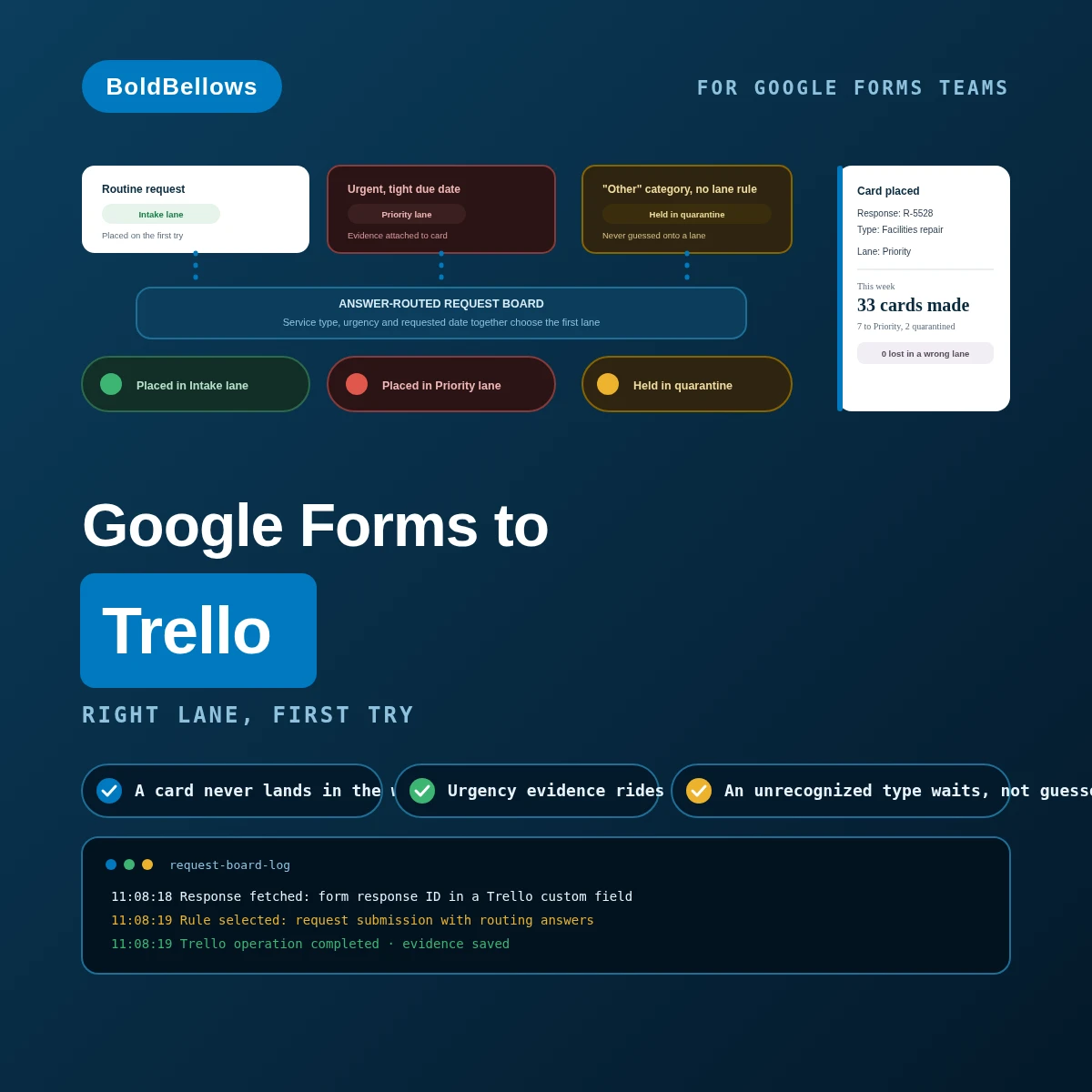
A staff member copying a request by hand often drops the exact answer that was supposed to set its priority. We read the declared service type, urgency and requested date together, so every new card lands in the lane it actually belongs in, with the evidence that justified it attached.
From $275, paid once.
No monthly connector fee.
01The one-inbox-lane trap
A generic connector or a manual copy usually drops every new request into the same starting list, leaving a person to reopen each card, reread the original answers, and manually move it to where it should have started.
Whoever copied the request into Trello wrote a short summary and, in the process, left out the exact detail that should have flagged it as priority.
Nothing checked the date against the team's actual lead time before it became a hard deadline on the card.
Someone picked "Other" and typed in a category the board had never seen, and the card landed wherever the connector happened to default.
A board's lanes are supposed to mean something. Landing every card in the same starting place just moves the triage work downstream instead of removing it.
Same form, same submissions. The difference is whether the routing decision happens once, automatically, or gets redone by hand on every single card.
Before
After
02How it works
The response gets claimed first, service type and urgency get evaluated together second, the card writes into its starting lane third, and a requested date gets adjusted against real lead-time rules before it ever becomes a due date.
03What powers the request board
The answer-to-lane router and requester reference ship with Starter. The due-date calculator and evidence fields join at Growth. The checklist selector and unmapped-answer quarantine complete the model at Scale.
StarterGrowthScale
Places every card from the declared request type, not a shared default inbox.
Stores the response linkage without exposing every raw answer in the card title.
Applies lead-time and working-day rules to whatever date was actually requested.
Preserves the exact answers that justified this card's priority and assignment.
Adds the procedure checklist that actually matches this request's category.
Keeps a new option out of an arbitrary lane until someone maps it properly.
Sets aside a request that doesn't cleanly match any lane rule until a person looks at it.
Real placements get checked closely against the routing rules for a full month.
04Who it's for
Service desk coordinators assigning work, facilities leads prioritizing requests, creative managers planning intake, and requesters who just want a clear handoff.
Assigns work off the board and needs a card's starting lane to already be correct.
Prioritizes physical requests and needs urgency answers to travel with the card.
Plans intake volume and wants unfamiliar request types caught before they clutter a lane.
Just wants a clear handoff and confidence their request landed somewhere it'll actually be seen.
05Compare
Creating a card for every new submission is a five-minute setup. Placing it in the lane it actually belongs in is the part most connectors skip entirely.
| What's checked | Single-lane automation | Copied in by hand | BoldBellows build |
|---|---|---|---|
| Lane placement | NoEvery card starts in the same list | PartialWhoever's copying has to remember the rules | YesSet from type and urgency together |
| Requested dates | NoSet as the due date exactly as typed | PartialAdjusted only if someone remembers to check | YesChecked against real lead-time rules first |
| Unfamiliar categories | NoLand in whatever the default happens to be | PartialGuessed at by whoever's handling intake | YesHeld in quarantine until properly mapped |
| A card that fails to create | PartialBuried somewhere only an admin would look | NoThe request just goes missing entirely | YesAutomatically re-attempted, tied to its response |
A requester chooses "Other" and types in a category with no matching lane rule. The router compares stable question identity against the approved mapping before it commits anything, rather than dropping the card into a guessed lane.
A requested date falls on a weekend or inside the team's minimum lead time. The due-date calculator shifts it to the nearest workable day automatically, and only flags the rare case it can't confidently resolve.
PricingClear, one-off packages
Choose how much due-date logic and card detail your board genuinely needs, and the total adjusts as you build. Routing your first board's intake costs $275 to set up.
View PricingPick a package, answer three short questions about intake, respondent matching and form-edit policy, and your price and turnaround move as you choose.
06The process
Starter's single-board scope keeps testing short, usually under a week. Growth's due-date logic and evidence fields need a little more time to get right against your team's actual lead times. Scale's checklist selection and quarantine handling, once proven against a genuinely varied intake, can run toward twelve days. On a tight rollout timeline? Say so early, and a quicker speed tier pulls the schedule forward.
We sit with whoever currently triages requests and turn their existing habits into a documented lane rule.
You approve the real minimum lead time per request type, and what happens when a requested date falls short of it.
We configure the capture, the routing logic and every Trello card field it's permitted to set.
An "Other" category with no lane rule, a requested date that lands on a weekend, and a resubmitted request from the same person all get thrown at it before launch.
Once live, the earliest cards get pulled and checked by hand against the responses that produced them.
07Security and ownership
This build is confined to one board and its named lists. Every other board, workspace and Butler automation you run in Trello remains entirely untouched by it.
Trello access is granted through a key and token limited to the single board this build serves.
Rather than guess, a category the router doesn't recognize holds in quarantine until a person maps it.
A field with no defined destination stays with the raw submission, never written onto a card by guesswork.
Nothing about the form or its script project ever exposes the key that authorizes a Trello write.
The custom-field linkage keeps a retried submission from creating a second card for the same request.
The lane rules and the due-date logic ship as source you own outright, free to change without us involved.
08In their words
Verified reviews from teams who use BoldBellows automations every day, from request triage and board hygiene to sales and support.
AI Translation & Localisation
When we expanded abroad we needed fast, accurate translations. BoldBellows built an AI translation system that turns our content into several languages instantly.
The translations read naturally and suit each culture. We now serve customers in five new countries without hiring translators. BoldBellows helped us go global.
AI Chatbot & Customer Support
BoldBellows built an AI support chatbot for our online boutique, and it has changed how we run the business. We used to have two full-time staff answering the same questions all day. Now the AI handles order tracking, product recommendations and even refund requests on its own.
What surprised me most is how natural it sounds. Customers compliment the ‘agent’ without realizing it’s AI. Our support workload dropped by 75% and customer satisfaction went up dramatically.
AI E-commerce Listings Automation
BoldBellows automated our product listings. The AI writes descriptions, organizes photos and publishes listings across several marketplaces.
It even answers customer questions instantly. Our store looks more professional and sales have noticeably increased.
AI Video & Voice Automation
We publish product videos every week, and BoldBellows introduced us to AI video automation. The system writes the script, voices it and produces the finished video in minutes.
The quality is remarkable: professional voiceovers, clean visuals and smooth editing. Production time went from three days to under 30 minutes, and we scaled our video marketing without adding cost.
AI CRM Automation
Our CRM was barely used because updating it by hand was tedious. BoldBellows automated data entry, tagging, segmentation and follow-ups.
Now the CRM is always up to date and our campaigns are far more accurate. It improved our whole sales pipeline.
AI HR & Recruitment Automation
Our HR team was drowning in applications. BoldBellows automated screening, skills-based filtering and interview scheduling.
It saves us hours every week and means we only interview qualified people. Hiring is now faster, better organized and more professional.
AI Lead Qualification & Sales Automation
Our sales team wasted hours chasing cold leads. BoldBellows built an AI lead-scoring system that reads behavior, email engagement and buying signals.
It filters out weak leads and sends personalized follow-ups automatically, so our team only talks to people who are ready to buy. Conversions rose 40% in the first month. It paid for itself straight away.
AI Booking & Scheduling Automation
Our coaching business needed a better way to schedule. BoldBellows automated all of it: bookings, reminders, cancellations and follow-ups.
No-shows fell by 60% and clients enjoy how smooth it is. It feels personal, not robotic. One of the best upgrades we’ve made.
AI Document & Contract Automation
Onboarding was slow because we wrote every contract by hand. BoldBellows automated the lot: contracts, welcome emails and client setup.
What took 48 hours now takes under 10 minutes, and clients regularly tell us how professional it feels.
AI Content & Social Media Automation
Our marketing agency couldn’t keep up with content. BoldBellows set up an AI content engine that writes blog posts and captions and even designs our social media creatives.
It spots trends and suggests topics for us, so we stay ahead of competitors. We now produce three times the content with the same team, and engagement has soared. They didn’t just automate our workflow, they lifted our whole brand.
AI Email & Smart Inbox Management
Our inbox used to be chaos. BoldBellows built an AI email system that sorts messages, drafts replies and flags anything urgent.
It learns how we write and gets better every week. We reply faster and no longer miss important messages. It feels like having a personal assistant working around the clock.
AI Workflow Automation for Agencies
Running a digital agency with many clients was overwhelming. BoldBellows built one automation dashboard that tracks tasks, sends updates and creates client reports automatically.
Clients love the transparency and we love the time we get back. Productivity is up, and project delays have dropped to almost zero.
AI Accounting & Invoice Automation
BoldBellows automated our whole invoicing process: creating invoices, sending reminders and tracking payments.
Late payments dropped sharply, and our accounting team finally has time for strategy instead of repetitive admin. Worth every penny.
AI Data Entry & Reporting Automation
We used to spend hours collecting data and building weekly reports by hand. BoldBellows automated all of it.
The reports are clean, visual and easy to read, and our managers rely on them for quick decisions. Human error is gone and our numbers are more accurate across the board.
AI Customer Journey Automation
We wanted a smoother path from first contact to purchase. BoldBellows built an AI system that guides each customer there automatically.
It sends personalized messages, recommends products and follows up at just the right moment. Customer retention has improved dramatically.
AI Social Comment & DM Automation
We get thousands of comments and messages every week. BoldBellows built an AI system that replies instantly, filters spam and surfaces the important ones.
Engagement is up and our page looks active around the clock. It’s like having a full social media team that never stops.
AI Voice Assistant
BoldBellows built a custom AI voice assistant for our customer hotline. It answers questions, books appointments and handles simple requests.
Customers love how fast it is, and our call-centre workload dropped dramatically. One of the smartest upgrades we’ve made.
AI Automation Partner
BoldBellows is hands-down the best AI automation partner we’ve worked with. Their systems are fast, reliable and built around how our business actually works.
Every automation they’ve delivered, from customer service to content, runs flawlessly. We’ve saved time, cut costs and grown faster than we expected.
09FAQ
Still unsure? We reply in plain English.
Whoever you've designated as the routing owner can see it sitting there, unassigned, until they define a lane for its category. It's never dropped into a guessed list just to move it out of sight.
Yes. Adding a new lane rule or retiring an old one touches only the routing table itself, not the capture code or anything else the board depends on.
Not necessarily. Butler automates actions inside Trello itself. This build exists specifically for intake that already lives in Google Forms and needs that routing decision made before a card even exists.
Not from us. It's a single build cost, full stop, and your Google Workspace and Trello subscriptions stay exactly as billed by their own providers.
A genuinely new category needs its own lane rule before it can route cleanly. Until it's added, a submission using it sits in quarantine rather than landing somewhere arbitrary.
The legacy response backfill extra covers that case. It runs each older submission through the same lane rules as live traffic, so a months-old request ends up exactly where a fresh one would. Related searches this service covers include google forms to trello, google forms responses to trello card and google forms trello integration.
Next stepStop reopening every card to figure out where it goes
Walk us through how your team currently sorts requests by hand, and we'll turn that into a routing rule Trello enforces on its own. Setup for your first board begins at $275.