"An auditor asked who approved a specific grant, and all we had was a channel message that said 'looks good.'"
With no structured decision captured, the actual approver and the exact moment of approval were both a guess.
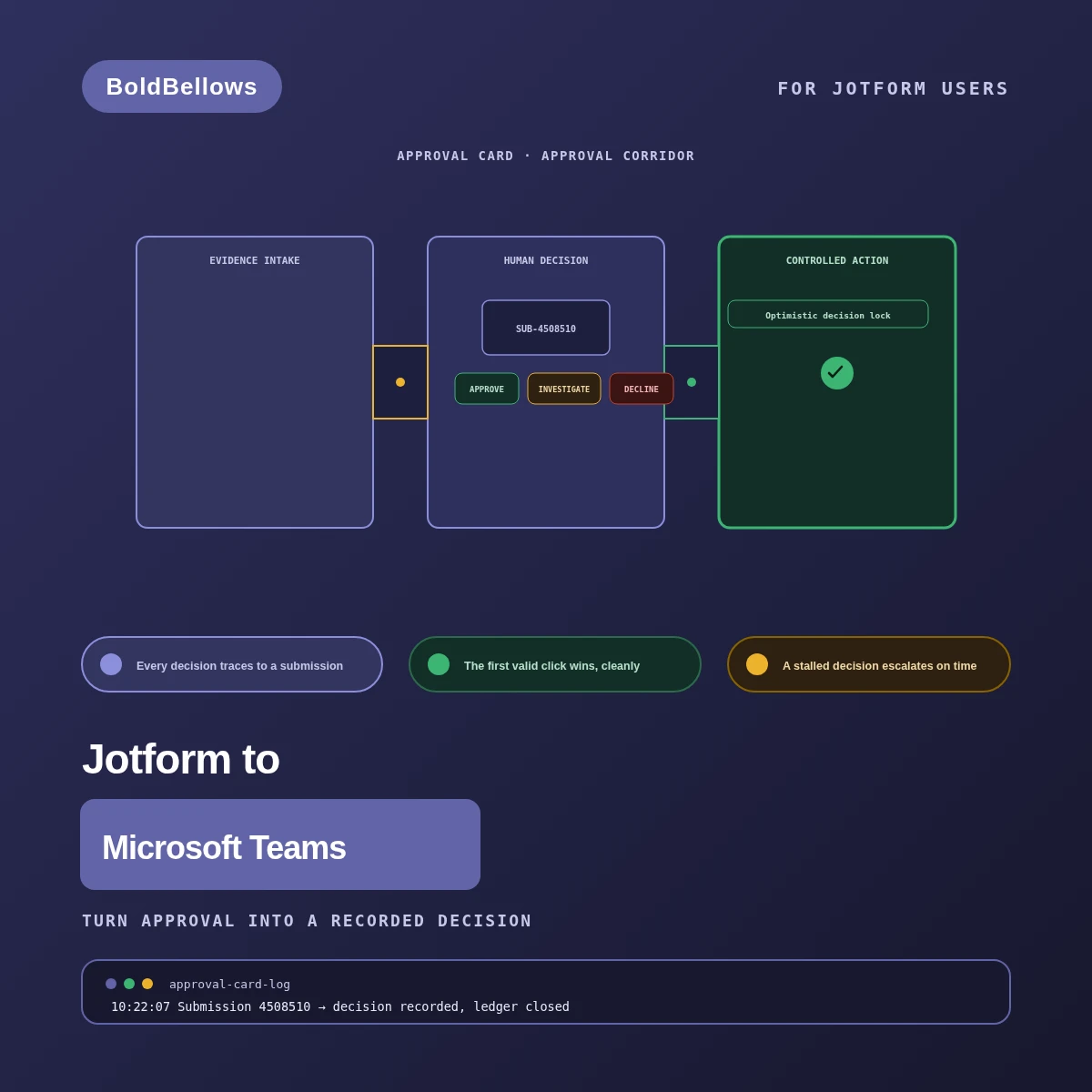
BoldBellowsTurn approval into a recorded decision
A plain notification in a channel invites exactly the outcome nobody wants — a conversation happens around it, someone eventually says "approved," and there's no durable record of who decided what or when. We post an Adaptive Card that carries the submission's identity invisibly, and every click writes straight to a traceable ledger.
From $435, paid once.
No monthly sync fee.
01The untraceable-decision trap
A basic notification dumps a submission into a channel and leaves it there. Whatever happens next — a thread reply, a thumbs-up emoji, a verbal "sounds good" in a meeting — is not a recorded decision. It's a conversation that leaves the actual approval undocumented.
With no structured decision captured, the actual approver and the exact moment of approval were both a guess.
Without a lock on the first valid decision, a near-simultaneous second click looked just as authoritative as the first.
Nothing re-checked the submission's current state before committing an outcome, so a stale card decided on outdated facts.
A decision that lives only in chat history isn't really a decision — it's a comment somebody made once. The submission-bound card and approval ledger exist so every "approved" or "declined" is an event with an actor, a time and a reason attached.
Same application form, same submissions. The difference is whether an approval is a structured, ledgered event, or a message that scrolled past in a channel.
Before
After
02How it works
A submission drops into the top tray as a raw record. It falls through into the middle tray, where the facts relevant to approval get shaped into a card. It settles into the bottom tray once a decision is confirmed and logged. A side gutter running alongside all three catches anything rejected or uncertain, so it never mixes back in with what already cleared.
03Inside the approval-card build
Approval Card ships with the decision-field allowlist and submission-bound card. The optimistic decision lock and change-before-action check join at Decision Workflow. An escalation clock and approval ledger complete the governed desk at Governed Review.
Approval CardDecision WorkflowGoverned Review
Shows reviewers only the Jotform answers relevant to the decision.
Carries the source submission's identity invisibly through the action.
Accepts the first valid decision and flags any conflicting second one.
Re-reads the submission fresh before committing an outcome.
Reassigns or reminds when a decision window runs out unanswered.
Records the actor, time, answer set and resulting status for every decision.
Finds a submission whose webhook silently never delivered a card at all.
Watches a real cycle of approvals before we sign off on the desk.
04Who it's for
Department approvers who need to show exactly why they signed off on something, HR operations leads tired of reconciling a decision against the original submission, grant committee coordinators wary of a form edit quietly rewriting the process, and Teams administrators who want a failed write handled visibly.
Can pull up exactly what they saw and clicked, months after the decision was made.
Stops manually cross-checking Teams messages against Jotform submissions after every dispute.
Trusts that a form edit reaches the approval card correctly, instead of silently going stale.
Sees exactly which card stalled and why, instead of a silent gap in the review desk.
05Compare
A quick webhook-to-channel setup will happily post a submission into Teams the second it arrives, with no structure around whatever conversation follows. Locking in a first decision, catching a late edit, and giving every approval a named actor is where that speed stops mattering.
| What a defensible approval needs | Plain channel message | Generic connector | BoldBellows build |
|---|---|---|---|
| Decision structure | Whatever gets typed in reply | No structured decision at all | YesAn Adaptive Card with real approve or decline actions |
| Conflict handling | Whoever replies last, effectively | Not detected at all | YesFirst valid decision locked, later ones flagged |
| Freshness check | Nobody re-reads the original form | Card content never updates | YesSubmission re-verified right before commit |
| Audit trail | A chat log, if it's even searchable | Not recorded anywhere durable | YesActor, time and outcome in a real ledger |
Two reviewers act on the same card within seconds of each other. The optimistic decision lock accepts whichever click actually landed first and routes the second one to a flagged conflict, instead of letting both silently apply.
The underlying submission changes after its approval card already posted. The change-before-action check re-reads the current state before committing, catching the drift instead of approving facts that no longer hold.
PricingClear, one-off packages
Approval Card, Decision Workflow and Governed Review differ mainly in how much conflict-handling and escalation logic sits around the base card. Walk us through how your team currently approves something in Jotform, and the price builds around your real process. Approval Card opens at $435.
View PricingPick a package, answer three short questions about event delivery, identity and exception handling, and your price and turnaround move as you choose.
06The process
Approval Card comes together fastest: one form, one channel and a single decision card, nothing more. Decision Workflow takes longer, since the decision lock has to be tested against a genuine near-simultaneous click before your team trusts it. Governed Review runs longest, because the escalation clock needs a real stalled decision to prove the reassignment path holds. Running approvals for more than one department? Tell us during scoping and we'll size the build around it from the start.
We sit in on a real approval as it happens today and note exactly where the paper trail currently breaks down.
You approve exactly which fields appear and which actions a reviewer can take before anything goes live.
The decision-field allowlist, card and identity key each connect through to your real Jotform form and the Teams channel you chose.
A near-simultaneous double-click, a late-edited submission and an out-of-order webhook all get thrown at it before launch day.
A genuine reviewer clicks approve or decline on an actual card while we watch it land in the ledger, before running unsupervised.
07Security and ownership
Jotform access covers only the form this desk was built around — every other form in your account stays invisible to it. In Teams, the workflow posts to the channel it was configured for and nowhere else.
What this build can see and write to is limited to the form and channel it was actually set up against.
An answer not on the reviewed list stays in Jotform — it never reaches the card in the first place.
The first click to actually land locks the outcome, so a near-simultaneous second one is caught, not overwritten.
A recoverable failure gets a handful of spaced attempts; anything still stuck becomes a task with a name on it.
What's kept for troubleshooting is who decided what and when — never a duplicate store of everything an applicant wrote.
The card design, decision lock and escalation rule all come documented at handoff, so your team owns every piece of it.
08In their words
Verified reviews from approval teams who trust BoldBellows to make a "yes" or "no" actually mean something on the record.
AI Content & Social Media Automation
Our marketing agency couldn’t keep up with content. BoldBellows set up an AI content engine that writes blog posts and captions and even designs our social media creatives.
It spots trends and suggests topics for us, so we stay ahead of competitors. We now produce three times the content with the same team, and engagement has soared. They didn’t just automate our workflow, they lifted our whole brand.
AI Translation & Localisation
When we expanded abroad we needed fast, accurate translations. BoldBellows built an AI translation system that turns our content into several languages instantly.
The translations read naturally and suit each culture. We now serve customers in five new countries without hiring translators. BoldBellows helped us go global.
AI Voice Assistant
BoldBellows built a custom AI voice assistant for our customer hotline. It answers questions, books appointments and handles simple requests.
Customers love how fast it is, and our call-centre workload dropped dramatically. One of the smartest upgrades we’ve made.
AI Email & Smart Inbox Management
Our inbox used to be chaos. BoldBellows built an AI email system that sorts messages, drafts replies and flags anything urgent.
It learns how we write and gets better every week. We reply faster and no longer miss important messages. It feels like having a personal assistant working around the clock.
AI Data Entry & Reporting Automation
We used to spend hours collecting data and building weekly reports by hand. BoldBellows automated all of it.
The reports are clean, visual and easy to read, and our managers rely on them for quick decisions. Human error is gone and our numbers are more accurate across the board.
AI Document & Contract Automation
Onboarding was slow because we wrote every contract by hand. BoldBellows automated the lot: contracts, welcome emails and client setup.
What took 48 hours now takes under 10 minutes, and clients regularly tell us how professional it feels.
AI Lead Qualification & Sales Automation
Our sales team wasted hours chasing cold leads. BoldBellows built an AI lead-scoring system that reads behavior, email engagement and buying signals.
It filters out weak leads and sends personalized follow-ups automatically, so our team only talks to people who are ready to buy. Conversions rose 40% in the first month. It paid for itself straight away.
AI HR & Recruitment Automation
Our HR team was drowning in applications. BoldBellows automated screening, skills-based filtering and interview scheduling.
It saves us hours every week and means we only interview qualified people. Hiring is now faster, better organized and more professional.
AI Workflow Automation for Agencies
Running a digital agency with many clients was overwhelming. BoldBellows built one automation dashboard that tracks tasks, sends updates and creates client reports automatically.
Clients love the transparency and we love the time we get back. Productivity is up, and project delays have dropped to almost zero.
AI Chatbot & Customer Support
BoldBellows built an AI support chatbot for our online boutique, and it has changed how we run the business. We used to have two full-time staff answering the same questions all day. Now the AI handles order tracking, product recommendations and even refund requests on its own.
What surprised me most is how natural it sounds. Customers compliment the ‘agent’ without realizing it’s AI. Our support workload dropped by 75% and customer satisfaction went up dramatically.
AI Video & Voice Automation
We publish product videos every week, and BoldBellows introduced us to AI video automation. The system writes the script, voices it and produces the finished video in minutes.
The quality is remarkable: professional voiceovers, clean visuals and smooth editing. Production time went from three days to under 30 minutes, and we scaled our video marketing without adding cost.
AI Booking & Scheduling Automation
Our coaching business needed a better way to schedule. BoldBellows automated all of it: bookings, reminders, cancellations and follow-ups.
No-shows fell by 60% and clients enjoy how smooth it is. It feels personal, not robotic. One of the best upgrades we’ve made.
AI Accounting & Invoice Automation
BoldBellows automated our whole invoicing process: creating invoices, sending reminders and tracking payments.
Late payments dropped sharply, and our accounting team finally has time for strategy instead of repetitive admin. Worth every penny.
AI E-commerce Listings Automation
BoldBellows automated our product listings. The AI writes descriptions, organizes photos and publishes listings across several marketplaces.
It even answers customer questions instantly. Our store looks more professional and sales have noticeably increased.
AI Customer Journey Automation
We wanted a smoother path from first contact to purchase. BoldBellows built an AI system that guides each customer there automatically.
It sends personalized messages, recommends products and follows up at just the right moment. Customer retention has improved dramatically.
AI Social Comment & DM Automation
We get thousands of comments and messages every week. BoldBellows built an AI system that replies instantly, filters spam and surfaces the important ones.
Engagement is up and our page looks active around the clock. It’s like having a full social media team that never stops.
AI CRM Automation
Our CRM was barely used because updating it by hand was tedious. BoldBellows automated data entry, tagging, segmentation and follow-ups.
Now the CRM is always up to date and our campaigns are far more accurate. It improved our whole sales pipeline.
AI Automation Partner
BoldBellows is hands-down the best AI automation partner we’ve worked with. Their systems are fast, reliable and built around how our business actually works.
Every automation they’ve delivered, from customer service to content, runs flawlessly. We’ve saved time, cut costs and grown faster than we expected.
09FAQ
Curious how the card would render one of your trickier applications? Request a quote and bring us a real submission, and we'll walk through exactly what a reviewer would see.
The built-in approvals app assumes the request is already structured inside Teams. It doesn't parse a Jotform webhook, resolve which submission a card belongs to, or handle a decision conflict — that translation layer is what this build provides.
A zap can drop a Jotform submission into a Teams message, but it stops there — nothing about it locks a decision or double-checks the submission before an outcome is final. Those safeguards are exactly what turns a message into a governed approval.
The change-before-action check catches it. The submission gets re-read right before a decision commits, so an edit that lands after the card posted but before the click is still accounted for.
It's not — the figure above covers only what we build. Your existing Microsoft licensing keeps billing exactly the way it does now, on its own.
It can, back through a period we scope out with you in advance. Each past decision gets entered into the same ledger structure a live one would use, so your review history reads consistently from day one.
Reviewer assignment lives as a configuration setting, separate from the card's own logic, so swapping who approves a form is a quick update rather than a rebuild. This page also answers searches for jotform to microsoft teams, jotform submissions teams notification and jotform microsoft teams integration.
Next stepStop letting decisions disappear into a chat
Bring one real submission, the decision it should trigger, and the reviewer disagreement your team has already run into once. Walk us through it, and a price follows. Approval Card starts at $435.