The enterprise account that lapsed
A past-due card for a large account sat among routine renewals and the invoice went unchased.
Paddle to Microsoft Teams automation for billing and success teams
Paddle to Microsoft Teams automation puts the billing events a team must act on in front of them. A past-due enterprise account, a record annual plan or a large refund matters; routine renewals do not. Paddle may deliver a notice more than once over three days. BoldBellows keeps the event ID, event type and transaction ID together as one key, does nothing until the transaction has left billed and draft, then applies your routing rules by plan and amount, builds an Adaptive Card from approved facts and sends it through a Teams workflow you own.
From $520, paid once. Post Paddle billing events to Microsoft Teams.
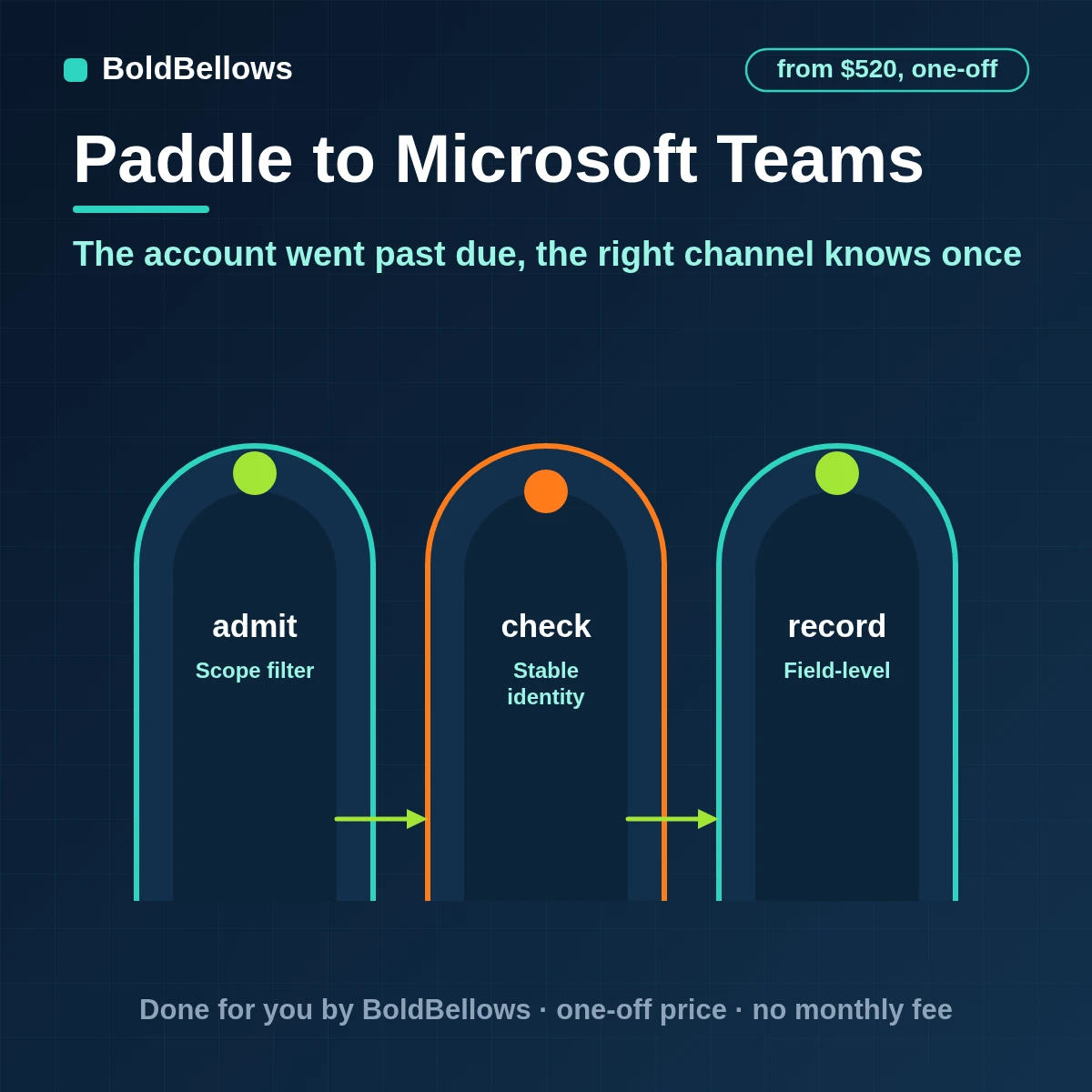
01 · the buried-alert problem
Paddle sends a notification for nearly everything: renewals, plan changes, address edits, adjustments. Pour them into Teams and the one card about an enterprise account turning past due sits among two hundred routine ones. Redeliveries within three days make it worse, and a workflow whose owner leaves stops posting without telling anyone.
A past-due card for a large account sat among routine renewals and the invoice went unchased.
Renewals, refunds and plan changes shared a feed, so each team skimmed everything.
A redelivered notification posted the same refund again the next day.
02 · how it works
Qualify first, match second, write last; that order is what stops duplicates.
The incoming Microsoft Teams event is checked for authenticity, its identifiers are recorded, and the route decides whether the billing event qualifies.
Once the event is verified, ordered and its ID stored, the channel is chosen from the event type, plan and amount, and a card is prepared with only the approved facts.
The Paddle card is posted through the workflow, its reference is stored, and an unsure result is searched for before anything is sent again.
Paddle Billing has its own API and webhook system, separate from Paddle Classic, and the brief confirms which one your account uses before anything is built.
Teams Workflows can receive a Paddle webhook request and post an Adaptive Card to a channel or chat, which is the supported route for programmatic messages.
Anything unclear is reconciled against Microsoft Teams through a source ID carried in the card facts, then repaired, closed or handed to an owner.
03 · what ships in the build
Three layers, in order: Capture for eligibility and identity, Coordinate for the Paddle card itself, Audit for drift and exceptions.
Searching for Paddle teams workflow? Also covered: Paddle to Microsoft Teams and Paddle Microsoft Teams API integration. Related searches include Paddle Microsoft Teams integration, Paddle power automate alternative, Paddle to teams without Zapier, Paddle transactions teams notification, Paddle past due alert teams, Paddle teams channel message, post Paddle transactions to teams channel, Paddle teams notification setup, Paddle Microsoft Teams duplicate prevention, Paddle teams adaptive card, Paddle to teams Zapier, teams alert when Paddle subscription cancels, connect Paddle to Microsoft Teams, Paddle teams alert automation, Paddle subscriptions teams webhook, Paddle refund notification teams, Paddle Microsoft Teams notifications and Paddle teams automation.
Applies the in-scope list to every Paddle event, so Microsoft Teams sees only what you approved.
CaptureStores the module, record ID and modified time beside the Microsoft Teams reference, so every write traces back to its source, on the Paddle to Microsoft Teams route.
CaptureDrops, masks or transforms each Paddle value according to the rule written beside it.
CaptureBuilds a short card with the amount, plan, event type and a link, using only allowlisted fields, in the Paddle to Microsoft Teams route.
CoordinateMatches each event to its card by a source ID carried in the card facts and flags the ones it cannot place.
CoordinateChooses the channel by event type, plan and size, for this Paddle to Microsoft Teams route.
CoordinateHolds every difference between Paddle and Microsoft Teams with its age and its owner.
AuditNotices a changed Paddle workflow owner, a renamed channel or a removed connection before cards stop arriving.
AuditOffers a safe next action for each stuck card instead of a blind retry, for this Paddle to Microsoft Teams route.
Audit04 · who it's for
If your team lives in Teams, the Paddle events that need action should arrive there once.
"Show me accounts going past due."
Past-due cards go to my channel the moment Paddle reports them.
"Refunds and credits need my eyes."
Adjustment cards go to finance, separate from renewals.
"Keep the workflow supportable."
The Paddle workflow owner, scopes and channel list are documented.
"Tell me about large annual plans."
A plan above your threshold posts a card to sales.
"Do not flood the channel."
Ordinary renewals stay out unless a rule sends them, for this Paddle to Microsoft Teams route.
"Keep my team informed, not distracted."
One clear card per Microsoft Teams event that matters.
Channels and cards decide the total
Packages begin at $520.
05 · compare your options
Each can send a message.
| What kicks it off | Forwarded emails | A generic Paddle connector | BoldBellows, with a Teams workflow gateway |
|---|---|---|---|
| What starts the work | Staff notice and act | The first matching notification | Events inside the agreed scope only |
| How identity is decided | A person recalls the customer | Nothing stored, so nothing to compare | A source ID carried in the Paddle card facts |
| What reaches Microsoft Teams | A partial copy | One object, no relationships | One structured card in the right channel with routing evidence |
| After an uncertain result | A manual clean-up later | It repeats the write | Compares what exists with what was intended |
In the Paddle to Microsoft Teams route, when an older event shows up after a newer one, the route notes it and leaves the confirmed card alone.
The existing card, if any, is found by a source ID carried in the card facts and judged against the payload before the route decides what to do.
The first design choice is a source ID carried in the card facts; identity, replay and repair all follow from it.
Pick a package, answer three short questions about how Paddle data should reach Microsoft Teams, and your price and turnaround move as you choose.
06 · process & getting started
The route is built in six steps, and nothing moves on until the last one is signed.
Which Paddle events deserve a Teams message, who needs each one and the channel where it belongs are listed together.
Access to Paddle and Microsoft Teams is set up with limited scope, and the fields that identify each record are chosen.
Channel rules, the facts each Paddle card may show and the workflow owner are written down and signed off.
For Paddle to Microsoft Teams, each failure path, from a lost reply to a rejected value, is exercised in a test Microsoft Teams before the live switch.
After the final test we enable the route and give you notes that name every owner and repair path.
Questions about how the route behaves in production are answered during the launch window, and the notes are updated.
07 · turnaround
Timing starts on access, and faster options shorten it, on the Paddle to Microsoft Teams route.
3 to 5 business days
5 to 8 business days
8 to 12 business days
08 · before we start
09 · security and ownership
Paddle keeps its data, Microsoft Teams receives only the approved subset, and we keep nothing beyond identifiers and outcomes.
Paddle and Microsoft Teams keep their own code and settings; the route sits between them and uses only what each platform documents.
Least-privilege access is the default, and it is documented.
The mapping names every field that travels. Additions are agreed in writing, not picked up automatically.
The route never resends on hope. It checks Microsoft Teams for the card through a source ID carried in the card facts and decides from what it finds.
The audit trail is made of IDs and decisions, not personal data.
After handover you can maintain, change or retire the route on your own.
10 · verified reviews
Verified reviews from business owners who use BoldBellows automations every day, from marketing and sales to support and operations.
AI Lead Qualification & Sales Automation
Our sales team wasted hours chasing cold leads. BoldBellows built an AI lead-scoring system that reads behavior, email engagement and buying signals.
It filters out weak leads and sends personalized follow-ups automatically, so our team only talks to people who are ready to buy. Conversions rose 40% in the first month. It paid for itself straight away.
AI Workflow Automation for Agencies
Running a digital agency with many clients was overwhelming. BoldBellows built one automation dashboard that tracks tasks, sends updates and creates client reports automatically.
Clients love the transparency and we love the time we get back. Productivity is up, and project delays have dropped to almost zero.
AI Document & Contract Automation
Onboarding was slow because we wrote every contract by hand. BoldBellows automated the lot: contracts, welcome emails and client setup.
What took 48 hours now takes under 10 minutes, and clients regularly tell us how professional it feels.
AI Social Comment & DM Automation
We get thousands of comments and messages every week. BoldBellows built an AI system that replies instantly, filters spam and surfaces the important ones.
Engagement is up and our page looks active around the clock. It’s like having a full social media team that never stops.
AI CRM Automation
Our CRM was barely used because updating it by hand was tedious. BoldBellows automated data entry, tagging, segmentation and follow-ups.
Now the CRM is always up to date and our campaigns are far more accurate. It improved our whole sales pipeline.
AI Voice Assistant
BoldBellows built a custom AI voice assistant for our customer hotline. It answers questions, books appointments and handles simple requests.
Customers love how fast it is, and our call-centre workload dropped dramatically. One of the smartest upgrades we’ve made.
AI Automation Partner
BoldBellows is hands-down the best AI automation partner we’ve worked with. Their systems are fast, reliable and built around how our business actually works.
Every automation they’ve delivered, from customer service to content, runs flawlessly. We’ve saved time, cut costs and grown faster than we expected.
AI Chatbot & Customer Support
BoldBellows built an AI support chatbot for our online boutique, and it has changed how we run the business. We used to have two full-time staff answering the same questions all day. Now the AI handles order tracking, product recommendations and even refund requests on its own.
What surprised me most is how natural it sounds. Customers compliment the ‘agent’ without realizing it’s AI. Our support workload dropped by 75% and customer satisfaction went up dramatically.
AI Content & Social Media Automation
Our marketing agency couldn’t keep up with content. BoldBellows set up an AI content engine that writes blog posts and captions and even designs our social media creatives.
It spots trends and suggests topics for us, so we stay ahead of competitors. We now produce three times the content with the same team, and engagement has soared. They didn’t just automate our workflow, they lifted our whole brand.
AI Video & Voice Automation
We publish product videos every week, and BoldBellows introduced us to AI video automation. The system writes the script, voices it and produces the finished video in minutes.
The quality is remarkable: professional voiceovers, clean visuals and smooth editing. Production time went from three days to under 30 minutes, and we scaled our video marketing without adding cost.
AI Email & Smart Inbox Management
Our inbox used to be chaos. BoldBellows built an AI email system that sorts messages, drafts replies and flags anything urgent.
It learns how we write and gets better every week. We reply faster and no longer miss important messages. It feels like having a personal assistant working around the clock.
AI Booking & Scheduling Automation
Our coaching business needed a better way to schedule. BoldBellows automated all of it: bookings, reminders, cancellations and follow-ups.
No-shows fell by 60% and clients enjoy how smooth it is. It feels personal, not robotic. One of the best upgrades we’ve made.
AI Translation & Localisation
When we expanded abroad we needed fast, accurate translations. BoldBellows built an AI translation system that turns our content into several languages instantly.
The translations read naturally and suit each culture. We now serve customers in five new countries without hiring translators. BoldBellows helped us go global.
AI HR & Recruitment Automation
Our HR team was drowning in applications. BoldBellows automated screening, skills-based filtering and interview scheduling.
It saves us hours every week and means we only interview qualified people. Hiring is now faster, better organized and more professional.
AI Accounting & Invoice Automation
BoldBellows automated our whole invoicing process: creating invoices, sending reminders and tracking payments.
Late payments dropped sharply, and our accounting team finally has time for strategy instead of repetitive admin. Worth every penny.
AI Data Entry & Reporting Automation
We used to spend hours collecting data and building weekly reports by hand. BoldBellows automated all of it.
The reports are clean, visual and easy to read, and our managers rely on them for quick decisions. Human error is gone and our numbers are more accurate across the board.
AI E-commerce Listings Automation
BoldBellows automated our product listings. The AI writes descriptions, organizes photos and publishes listings across several marketplaces.
It even answers customer questions instantly. Our store looks more professional and sales have noticeably increased.
AI Customer Journey Automation
We wanted a smoother path from first contact to purchase. BoldBellows built an AI system that guides each customer there automatically.
It sends personalized messages, recommends products and follows up at just the right moment. Customer retention has improved dramatically.
11 · questions
Short answers to what people ask before they book. Anything else can go in your quote request.
Need only a message for every notification? A zap handles that. It stops short of the work to direct the card to the right channel, survive a changed workflow owner or learn whether a card already went out. That missing layer is what you are paying for.
When a notification arrives, the route verifies it, applies your routing rule and sends one Adaptive Card through a Teams workflow you own.
Yes. A routing table maps each event type, plan and amount band to a channel, so a past-due account reaches success while a refund reaches finance.
The Paddle event ID is kept in the card facts and stored by the route, so a redelivered notification finds the card that already exists.
Yes. A card shows allowlisted facts only; everything else stays in Paddle.
The next event fails visibly, the cause is reported to a named owner and the Microsoft Teams card is retried later under the same key.
It can send a Microsoft Teams webhook to an address you give it, but it cannot pick a channel or build a card. This build does both.
We do it for every route. The Paddle Microsoft Teams field mapping service gives you a document, not a promise, listing each field that will cross.
Yes. Each branch you need is documented, giving a custom Paddle workflow for Microsoft Teams. We act as the Paddle Microsoft Teams integration consultant on the project, from $520.
We write down what the route assumes. When an assumption stops being true, the route stops that step and says so, rather than improvising.
Let the right team hear about it once for Paddle to Microsoft Teams
We scope how to automate Paddle data to Microsoft Teams against it, and Capture begins at $520.
If your process has extra branches, we will price them on their own line.