Counts typed in twice
From clipboard to spreadsheet.
Inventory counts for kitchens that find out about shortages at service
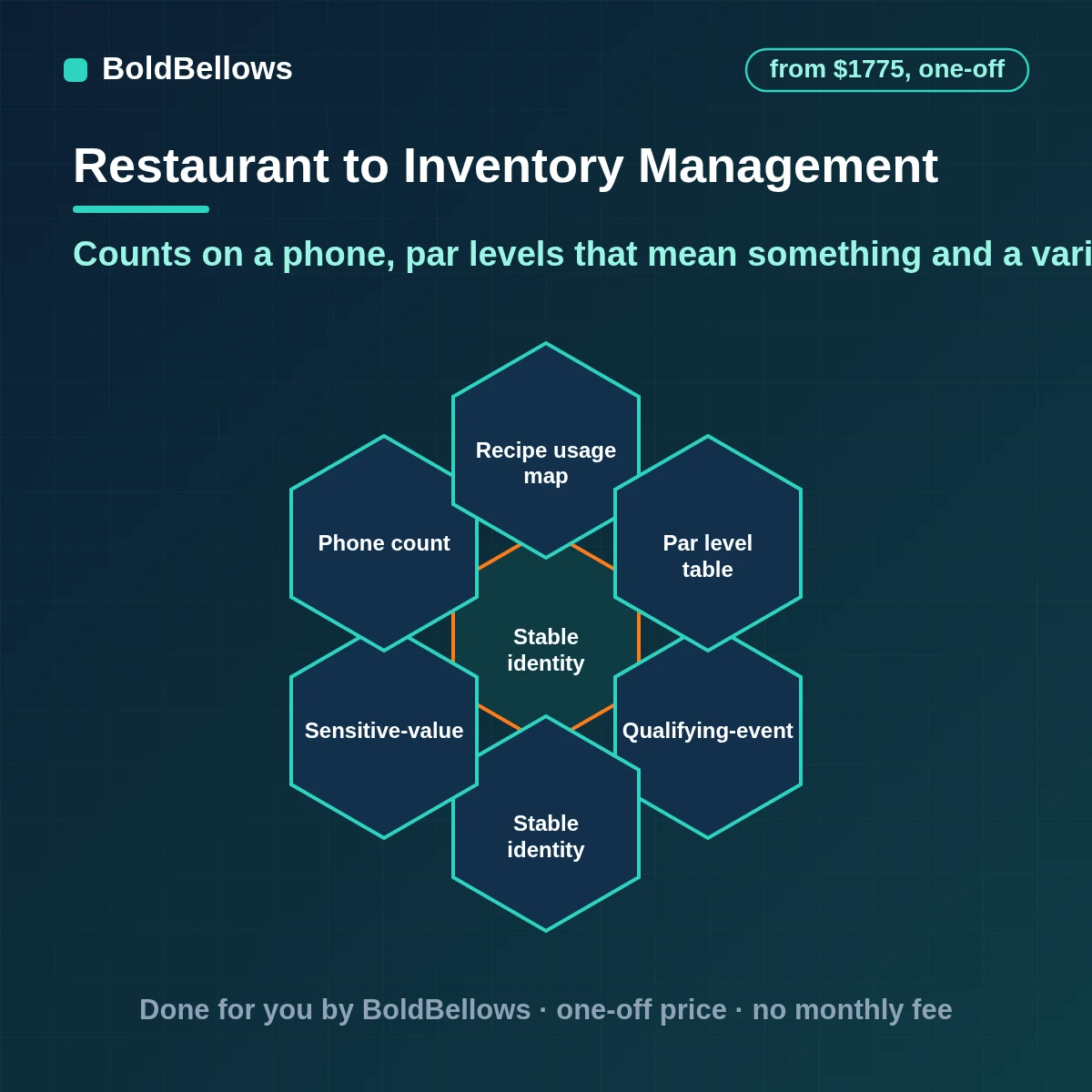
A weekly count is only as useful as the comparison made with it, because quantities on a shelf mean little until they sit beside what the week's sales should have used. BoldBellows records the ingredient, the unit and the storage area each time a count is entered, compares every count with the use your sales and recipes predict, flags what sits under its par level and shows the gap in food cost instead of hiding it, then builds the route around how your stock is really held: counts are entered on a phone or tablet by storage area and in the units you order by, POS sales are turned into expected use through your recipes, par levels per item show what needs ordering, and a variance list ranks the ingredients where counted use and expected use disagree most. Over-portioning, waste, receiving errors and recipe drift all show up the same way, so the list gives the chef a place to look and does not hand down a verdict.
From $1,775, paid once. Counts on a phone.
B2Before and after
Inventory is counted on Sunday night with a clipboard, typed into a spreadsheet on Monday and corrected on Wednesday after someone finds a mistake. By then the week is over. Even a clean count only says what is on the shelf, not whether that is the right amount, because the missing half is what the kitchen should have used. Without expected use, a high food cost is just a feeling, and the chef has no list of ingredients to look at first.
Sound familiar?
From clipboard to spreadsheet.
Cases, pounds and each are mixed.
Nobody wrote them down.
Sales and stock never meet.
The gap appears at month's end.
The count was a week old.
Before
After
D4How it works
The route reads, decides, searches and only then changes the stock ledger.
The route records who, what and when for the Restaurant event, then judges it against your rule.
Counts are entered by area, converted to ordering units and compared with expected use.
Items under par are flagged and the variance list ranks the biggest gaps for the chef.
E5Inside your ledger
What you choose is how far to go: Start gets one route live, Orchestrate adds the branching, Command adds continuous checking.
Start
Verifies the service event is real, current and in scope before any write is planned.
Start
Holds the Restaurant identifier next to the inventory management outcome it created, which lets a retry confirm the work rather than repeat it.
Start
Keeps private Restaurant values out of the stock ledger unless the map says they may cross.
Orchestrate
Takes counts by storage area and unit.
Orchestrate
Turns POS sales into expected use.
Orchestrate
Holds the target quantity for each item.
Command
Ranks gaps between counted and expected use.
Command
Shows cost movement by category.
Command
Parks doubtful Restaurant events with their evidence until a person decides.
From restaurant stock count automation to restaurant inventory alert and restaurant stock tracking automation, one route. Related searches include restaurant inventory management implementation, restaurant variance report, restaurant inventory management historical migration, restaurant inventory management duplicate prevention, restaurant ingredient tracking, restaurant supplier ordering, bar inventory count automation, theoretical vs actual food cost, restaurant food cost automation, restaurant inventory automation, restaurant inventory spreadsheet, restaurant purchase order automation, restaurant inventory management error handling, restaurant inventory automation service, restaurant food waste tracking, restaurant low stock notification, restaurant inventory management consultant and restaurant par levels.
G7Who it is for
Cooks want counting that takes minutes, and owners want the count to explain food cost and not just state it.
"Know what to look into."
The variance list names the items.
"Count faster."
The sheet follows the shelves.
"Understand food cost."
Cost movement is explained by item.
"Order against a target."
Par levels are written down.
"Track spirits and kegs."
Counts live in the same ledger.
"Get clean numbers."
Counts arrive dated and in units.
You pay for ingredients, units and storage areas
Decide the scope of Restaurant inventory management in the panel below and read a firm figure and a delivery range. It begins at $1,775.
One setup fee
I9Your options
Each can record a count. Only one converts units, compares use with sales and ranks the gaps worth looking at.
| How stock is counted | A weekly spreadsheet | A stock app alone | Our stock ledger route |
|---|---|---|---|
| What starts the work | A person decides case by case | Any change that matches the filter | A service event that clears the admission check |
| How identity is decided | By the title someone typed | Matching on the text as it arrives | Ingredient, unit and count date |
| What reaches the stock ledger | Screenshots and notes | The fields the template lists | A dated count with expected use and a ranked variance |
| After an uncertain result | Ask around and fix it by hand | Retries until it works or fails | Checks the stock ledger, records the outcome, then acts |
If Restaurant delivers an event late, it is compared with the stored state and cannot move the count backwards.
Both counts are kept with the names of who entered them, the difference is flagged and the sous chef settles the figure before the ledger updates. The route reads the stock ledger through the ingredient, the unit and the count date and labels the result before it touches anything. An existing count is updated, never duplicated.
We agree the ingredient, the unit and the count date before anything else, since matching, replay and repair all use it.
Pick a package, answer three short questions about how Restaurant data should reach Inventory Management, and your price and turnaround move as you choose.
J11The process
Six deliberate steps keep a small project from turning into a long one.
We look at your count sheets, the order guide and the way units are used to find where numbers get lost.
A restricted login for Restaurant comes first, the same for every tool inventory management writes to, followed by an agreed list of matching keys.
Storage areas, units, par levels and which recipes drive expected use are written out and approved first.
Missing fields, odd characters, repeated events and revoked access are fed through a test the stock ledger on purpose.
Go-live begins at an agreed checkpoint, and a PDF then explains each rule and safeguard.
Thresholds, branches and owners are adjusted after the first real runs, then the notes are finalized, for this Restaurant Inventory Management service.
K12Turnaround
The range begins on the day access to Restaurant and the connected tools is confirmed.
6 to 10 business days
10 to 16 business days
16 to 24 business days
L13Getting started
M14Safety and ownership
Restaurant data is read through an account you control, kept to the inventory management fields, and never copied beyond what is needed.
The logic lives in the route, not inside Restaurant or the stock ledger, which means removing it later leaves both tools as they were.
The route asks for read rights where it only needs to read.
Only the values in the approved map are written to the count; the rest of the record stays where it began.
Because the ingredient, the unit and the count date is stored with each count, a retry can tell 'already there' from 'never arrived'.
Diagnostics record status codes and checkpoints, nothing sensitive.
At the end you receive the full documentation and can run the route without us.
N15In their words
Verified reviews from business owners who use BoldBellows automations every day, from marketing and sales to support and operations.
AI Lead Qualification & Sales Automation
Our sales team wasted hours chasing cold leads. BoldBellows built an AI lead-scoring system that reads behavior, email engagement and buying signals.
It filters out weak leads and sends personalized follow-ups automatically, so our team only talks to people who are ready to buy. Conversions rose 40% in the first month. It paid for itself straight away.
AI Data Entry & Reporting Automation
We used to spend hours collecting data and building weekly reports by hand. BoldBellows automated all of it.
The reports are clean, visual and easy to read, and our managers rely on them for quick decisions. Human error is gone and our numbers are more accurate across the board.
AI Voice Assistant
BoldBellows built a custom AI voice assistant for our customer hotline. It answers questions, books appointments and handles simple requests.
Customers love how fast it is, and our call-centre workload dropped dramatically. One of the smartest upgrades we’ve made.
AI Automation Partner
BoldBellows is hands-down the best AI automation partner we’ve worked with. Their systems are fast, reliable and built around how our business actually works.
Every automation they’ve delivered, from customer service to content, runs flawlessly. We’ve saved time, cut costs and grown faster than we expected.
AI Chatbot & Customer Support
BoldBellows built an AI support chatbot for our online boutique, and it has changed how we run the business. We used to have two full-time staff answering the same questions all day. Now the AI handles order tracking, product recommendations and even refund requests on its own.
What surprised me most is how natural it sounds. Customers compliment the ‘agent’ without realizing it’s AI. Our support workload dropped by 75% and customer satisfaction went up dramatically.
AI Content & Social Media Automation
Our marketing agency couldn’t keep up with content. BoldBellows set up an AI content engine that writes blog posts and captions and even designs our social media creatives.
It spots trends and suggests topics for us, so we stay ahead of competitors. We now produce three times the content with the same team, and engagement has soared. They didn’t just automate our workflow, they lifted our whole brand.
AI Video & Voice Automation
We publish product videos every week, and BoldBellows introduced us to AI video automation. The system writes the script, voices it and produces the finished video in minutes.
The quality is remarkable: professional voiceovers, clean visuals and smooth editing. Production time went from three days to under 30 minutes, and we scaled our video marketing without adding cost.
AI Email & Smart Inbox Management
Our inbox used to be chaos. BoldBellows built an AI email system that sorts messages, drafts replies and flags anything urgent.
It learns how we write and gets better every week. We reply faster and no longer miss important messages. It feels like having a personal assistant working around the clock.
AI Workflow Automation for Agencies
Running a digital agency with many clients was overwhelming. BoldBellows built one automation dashboard that tracks tasks, sends updates and creates client reports automatically.
Clients love the transparency and we love the time we get back. Productivity is up, and project delays have dropped to almost zero.
AI Booking & Scheduling Automation
Our coaching business needed a better way to schedule. BoldBellows automated all of it: bookings, reminders, cancellations and follow-ups.
No-shows fell by 60% and clients enjoy how smooth it is. It feels personal, not robotic. One of the best upgrades we’ve made.
AI Translation & Localisation
When we expanded abroad we needed fast, accurate translations. BoldBellows built an AI translation system that turns our content into several languages instantly.
The translations read naturally and suit each culture. We now serve customers in five new countries without hiring translators. BoldBellows helped us go global.
AI HR & Recruitment Automation
Our HR team was drowning in applications. BoldBellows automated screening, skills-based filtering and interview scheduling.
It saves us hours every week and means we only interview qualified people. Hiring is now faster, better organized and more professional.
AI Accounting & Invoice Automation
BoldBellows automated our whole invoicing process: creating invoices, sending reminders and tracking payments.
Late payments dropped sharply, and our accounting team finally has time for strategy instead of repetitive admin. Worth every penny.
AI E-commerce Listings Automation
BoldBellows automated our product listings. The AI writes descriptions, organizes photos and publishes listings across several marketplaces.
It even answers customer questions instantly. Our store looks more professional and sales have noticeably increased.
AI Customer Journey Automation
We wanted a smoother path from first contact to purchase. BoldBellows built an AI system that guides each customer there automatically.
It sends personalized messages, recommends products and follows up at just the right moment. Customer retention has improved dramatically.
AI Document & Contract Automation
Onboarding was slow because we wrote every contract by hand. BoldBellows automated the lot: contracts, welcome emails and client setup.
What took 48 hours now takes under 10 minutes, and clients regularly tell us how professional it feels.
AI Social Comment & DM Automation
We get thousands of comments and messages every week. BoldBellows built an AI system that replies instantly, filters spam and surfaces the important ones.
Engagement is up and our page looks active around the clock. It’s like having a full social media team that never stops.
AI CRM Automation
Our CRM was barely used because updating it by hand was tedious. BoldBellows automated data entry, tagging, segmentation and follow-ups.
Now the CRM is always up to date and our campaigns are far more accurate. It improved our whole sales pipeline.
P16FAQ
If you are weighing this up, these are the points that usually matter.
If a low-stock reminder is the whole job, use a zap. If the job also means you must separate what sales say was used from what the shelf says, or point at a gap in food cost, it is not. Everything in that list is included in the scope.
On a phone or tablet, shelf by shelf, in the units you order by.
The quantity your sales should have consumed, calculated from recipes and POS sales.
No. It shows what is under par, and ordering is handled by the supplier reorder service or by your team.
Waste, portioning, receiving mistakes and outdated recipes all can, so the list tells you where to check.
Yes, bottles and kegs can be counted in the same ledger with their own units.
As often as you decide; many kitchens count key items more often than the rest.
Yes. We draw up the field map for Restaurant inventory management, you check it line by line, and nothing is built until you agree.
Yes. We write your conditions for inventory management into the build, from $1,775.
Each external dependency is recorded. If one changes, the route refuses to guess and flags the record. Repair after the review period is a new, priced task.
Q17Count once and know what it means
One trigger, one result, one person for exceptions: with those, Restaurant inventory management is priced from $1,775.
Tell us about the complications and we will fold them into a custom quote.