Net payouts, gross sales
One payout can cover hundreds of orders. Recorded as a single deposit, it hides which sales, fees and refunds are inside it, so the month never ties out.
BoldBellowsDone-for-you Shopify bookkeeping
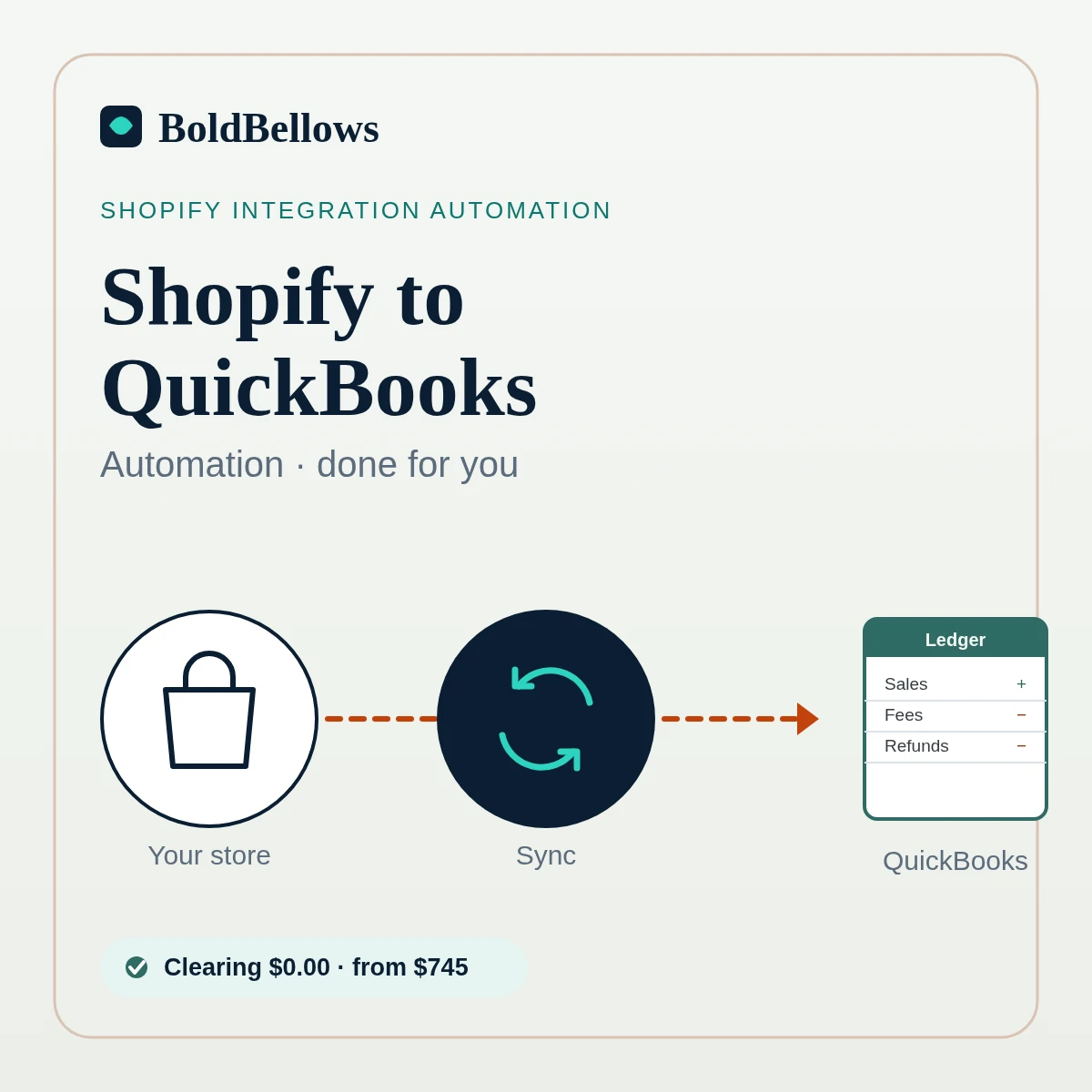
Our Shopify to QuickBooks integration posts your daily sales, Shopify Payments fees, refunds and sales tax into QuickBooks Online on their own, then matches every payout to the bank deposit through a clearing account that returns to zero. No manual journals, no month-end guesswork, and no monthly app. We build it, check it against your own Shopify finance summary, and hand over books you own.
One-off setup from $745
No monthly subscription
Chapter 01The payout that never matches
A Shopify payout is a net figure: sales, minus Shopify Payments fees, minus refunds and adjustments, paid to your bank as one lump sum. If your books only record gross sales, or only the deposit, the two never line up. Good Shopify QuickBooks reconciliation means holding sales in a clearing account and letting each payout empty it, to the cent.
The deposit in the bank is never the same as the sales figure, and nobody could tell me why.
One payout can cover hundreds of orders. Recorded as a single deposit, it hides which sales, fees and refunds are inside it, so the month never ties out.
Shopify Payments fees come out before the money lands. Post the deposit as income and your revenue is understated and your fees are invisible.
A refund three weeks after the sale lands in a later payout. Booked to the wrong month, it quietly overstates one month's profit and understates the next.
Before
After
Chapter 02How it works
One direction, three parts. We read from Shopify, split each payout into the entries an accountant expects, and post them into QuickBooks Online against your own chart of accounts. Your store and your ledger both stay exactly as they are; we only add clean, checked entries.
You set up a read-only app in Shopify, following the short guide we send. It can view orders, fees and payouts, but write nothing. Shopify shares only the last 60 days by default, so if you want older months back-posted we request that permission too.
Each payout is split into sales income, Shopify fees, refunds and the sales tax you collected, then the net is transferred to the bank. A scheduled re-check catches any order Shopify updated after the fact, so nothing is missed or double-counted.
Entries land on your own chart of accounts, not a generic template, so your profit and loss reads the way your accountant set it up. This Shopify QuickBooks accounting sync fits your books, rather than asking your books to fit it.
Chapter 03The ledger
Each part of a sale lands in the right account, so your reports are correct without a single manual journal. The accounts you get depend on your package, and every Shopify mapping can be adjusted during your rounds of changes.
Product sales, net of discounts, posted daily or per order so your revenue is right.
Payment processing fees on their own expense account, so they show on the profit and loss.
The tax you collected held as a liability, so your Shopify tax QuickBooks sync matches your filing.
Holds each payout's sales until the deposit empties it. The balance returns to zero every cycle.
Refunds and partial refunds posted on the date they happened, in the payout that carried them.
Cost of goods and an inventory journal, which the official connector no longer keeps in step.
Orders in other currencies posted in your home currency, with exchange gains and losses.
Sales split by channel or store, so a growing brand sees each part of the business on its own.
Chapter 04Who it is for
If month-end means chasing a payout that will not tie out, a proper Shopify QuickBooks integration gives you that afternoon back.
Payouts that reconcile themselves and a clearing account that zeroes, so a client's month-end is a review, not a rebuild.
A profit and loss you can trust on the first of the month, with Shopify fees and refunds where they belong.
A repeatable setup for every Shopify client, mapped to the chart of accounts your firm already uses.
Orders in several currencies posted in your home currency, with the classes to see each store or channel apart.
Chapter 05The options
Each option can post something. The difference shows up at month-end, when the payout has to match the bank and the sales tax has to match your filing.
| Question | Manual entry | Official connector | Zapier or Make | BoldBellows build |
|---|---|---|---|---|
| Reconciles payouts to the bank | By hand, every payout | Summary or per transaction, you build the clearing | Not really its job | Clearing account that zeroes each payout |
| Fees and refunds split out | Only if you remember | Some, in its own format | Rarely | Every payout, on named accounts |
| Sales tax tracked to file | A separate spreadsheet | Basic tax handling | Not handled | Liability, split by state if you need it |
| Cost of goods and inventory | Worked out later | No longer synced | No | Journal in the Full Ledger package |
| Multi-currency | Converted by hand | Not supported | Depends on the setup | Posted in your home currency |
| Cost over time | Free, but hours every month | Free, but you build and maintain it | Monthly, and tasks add up | One-off price from $745 |
| Where it lives | In your head and a spreadsheet | Their app, their rules | Runs on their service | Your own QuickBooks company |
A note on the official connector. Intuit's Shopify Connector is free and fine for simple stores, but the rebuilt version no longer syncs inventory and does not handle multi-currency, and you still design the clearing and tax logic yourself. If you would rather feed a live sheet instead, our Shopify to Google Sheets automation covers reporting, and UK, Australian and New Zealand books are usually better served by Shopify to Xero automation. A Shopify to QuickBooks Zapier build, by contrast, tends to post one event at a time and rarely reconciles a payout.
InterludeA quieter month-end
Choose a package, answer a few short questions about your books, and the exact price and delivery window appear before you commit. Most builds run about 5 to 20 working days, and you can pay to move up the queue.
One-off price from $745 · You own everything we build
Choose a package, answer five short questions about your books, and your price and delivery date update as you go. No surprises, and nothing is added unless you ask for it.
Chapter 06The process
Six steps. You spend about an hour in total across the project, starting with roughly ten minutes to give access. We build, check and post the rest, and you sign off a full month before we hand over.
About 30 minutes
A short online brief. You share your chart of accounts and how you file sales tax today, and we agree exactly which accounts each part of a sale will land in.
About 10 minutes
You create a read-only Shopify app and connect QuickBooks Online. Each step comes with a written guide and screenshots, and we never need your bank login.
Most of the project
We connect the store, build the accounts, the clearing logic and the tax handling, and back-post the history you asked for.
Before you see it
Sales, fees, refunds and tax are matched to your Shopify finance summary for the same dates, and the clearing account is proven to return to zero.
Two to four rounds
You and your accountant look at a real month in QuickBooks. Account names, tax treatment, the level of detail: that is what the rounds are for.
Handover day
Premium handover notes as a PDF, covering every account and the month-end routine, and books that carry on posting themselves long after we step back.
Chapter 07Trust
Your ledger and your customer list are sensitive. We take the least access that does the job, keep personal details out of the books unless you want them, and hand everything back the moment you ask.
We read orders, fees and payouts. We cannot change orders, products or prices in your store, even by accident.
Customer names and emails can be left out of QuickBooks entirely, or masked, so the books hold figures rather than personal data.
We post entries; we do not connect to or move money in your bank. The deposit is matched, never initiated.
One click on the app, or disconnecting QuickBooks, ends our access that minute. Nothing else to cancel.
The sync moves data from Shopify into your QuickBooks. We do not keep copies of your orders or ledger on our servers.
The mapping and the posting rules live in your own QuickBooks company. There is no monthly fee to keep the books current.
"We prove the clearing account zeroes on a real month before your books ever become ours to hand over."
Steven GrratFounder, BoldBellows
Chapter 08In their words
Verified reviews from business owners who use BoldBellows automations every day, from accounting and reporting to sales, support and operations.
AI Accounting & Invoice Automation
BoldBellows automated our whole invoicing process: creating invoices, sending reminders and tracking payments.
Late payments dropped sharply, and our accounting team finally has time for strategy instead of repetitive admin. Worth every penny.
AI Data Entry & Reporting Automation
We used to spend hours collecting data and building weekly reports by hand. BoldBellows automated all of it.
The reports are clean, visual and easy to read, and our managers rely on them for quick decisions. Human error is gone and our numbers are more accurate across the board.
AI CRM Automation
Our CRM was barely used because updating it by hand was tedious. BoldBellows automated data entry, tagging, segmentation and follow-ups.
Now the CRM is always up to date and our campaigns are far more accurate. It improved our whole sales pipeline.
AI Chatbot & Customer Support
BoldBellows built an AI support chatbot for our online boutique, and it has changed how we run the business. We used to have two full-time staff answering the same questions all day. Now the AI handles order tracking, product recommendations and even refund requests on its own.
What surprised me most is how natural it sounds. Customers compliment the ‘agent’ without realizing it’s AI. Our support workload dropped by 75% and customer satisfaction went up dramatically.
AI Workflow Automation for Agencies
Running a digital agency with many clients was overwhelming. BoldBellows built one automation dashboard that tracks tasks, sends updates and creates client reports automatically.
Clients love the transparency and we love the time we get back. Productivity is up, and project delays have dropped to almost zero.
AI Automation Partner
BoldBellows is hands-down the best AI automation partner we’ve worked with. Their systems are fast, reliable and built around how our business actually works.
Every automation they’ve delivered, from customer service to content, runs flawlessly. We’ve saved time, cut costs and grown faster than we expected.
AI Lead Qualification & Sales Automation
Our sales team wasted hours chasing cold leads. BoldBellows built an AI lead-scoring system that reads behavior, email engagement and buying signals.
It filters out weak leads and sends personalized follow-ups automatically, so our team only talks to people who are ready to buy. Conversions rose 40% in the first month. It paid for itself straight away.
AI Customer Journey Automation
We wanted a smoother path from first contact to purchase. BoldBellows built an AI system that guides each customer there automatically.
It sends personalized messages, recommends products and follows up at just the right moment. Customer retention has improved dramatically.
AI E-commerce Listings Automation
BoldBellows automated our product listings. The AI writes descriptions, organizes photos and publishes listings across several marketplaces.
It even answers customer questions instantly. Our store looks more professional and sales have noticeably increased.
AI Content & Social Media Automation
Our marketing agency couldn’t keep up with content. BoldBellows set up an AI content engine that writes blog posts and captions and even designs our social media creatives.
It spots trends and suggests topics for us, so we stay ahead of competitors. We now produce three times the content with the same team, and engagement has soared. They didn’t just automate our workflow, they lifted our whole brand.
AI Video & Voice Automation
We publish product videos every week, and BoldBellows introduced us to AI video automation. The system writes the script, voices it and produces the finished video in minutes.
The quality is remarkable: professional voiceovers, clean visuals and smooth editing. Production time went from three days to under 30 minutes, and we scaled our video marketing without adding cost.
AI Email & Smart Inbox Management
Our inbox used to be chaos. BoldBellows built an AI email system that sorts messages, drafts replies and flags anything urgent.
It learns how we write and gets better every week. We reply faster and no longer miss important messages. It feels like having a personal assistant working around the clock.
AI Booking & Scheduling Automation
Our coaching business needed a better way to schedule. BoldBellows automated all of it: bookings, reminders, cancellations and follow-ups.
No-shows fell by 60% and clients enjoy how smooth it is. It feels personal, not robotic. One of the best upgrades we’ve made.
AI Translation & Localisation
When we expanded abroad we needed fast, accurate translations. BoldBellows built an AI translation system that turns our content into several languages instantly.
The translations read naturally and suit each culture. We now serve customers in five new countries without hiring translators. BoldBellows helped us go global.
AI HR & Recruitment Automation
Our HR team was drowning in applications. BoldBellows automated screening, skills-based filtering and interview scheduling.
It saves us hours every week and means we only interview qualified people. Hiring is now faster, better organized and more professional.
AI Document & Contract Automation
Onboarding was slow because we wrote every contract by hand. BoldBellows automated the lot: contracts, welcome emails and client setup.
What took 48 hours now takes under 10 minutes, and clients regularly tell us how professional it feels.
AI Social Comment & DM Automation
We get thousands of comments and messages every week. BoldBellows built an AI system that replies instantly, filters spam and surfaces the important ones.
Engagement is up and our page looks active around the clock. It’s like having a full social media team that never stops.
AI Voice Assistant
BoldBellows built a custom AI voice assistant for our customer hotline. It answers questions, books appointments and handles simple requests.
Customers love how fast it is, and our call-centre workload dropped dramatically. One of the smartest upgrades we’ve made.
Chapter 09Questions
What Shopify owners and their bookkeepers ask us most before they start.
The official connector is a good start for a simple store, but you still design the clearing account, the tax treatment and the mapping to your own accounts, and the rebuilt version no longer syncs inventory or handles multi-currency. We build all of that around your books, check it against Shopify, and you pay once instead of maintaining it yourself.
Yes, that is the heart of a proper Shopify QuickBooks reconciliation. Each payout posts its sales, fees and refunds into a clearing account, and the net transfer to the bank empties that account back to zero. When the clearing balance is zero, the payout and the deposit agree to the cent.
Either. Many stores want a daily summary journal, which keeps QuickBooks tidy. If you need order-level detail, or a sales receipt or invoice per order for B2B customers, we post that instead. You choose the level of detail in the pricing below.
We can, when order-level posting is turned on, so Shopify customers appear in QuickBooks against their sales. Just as often, owners prefer to keep personal details out of the books and post summaries, and we mask or omit customer data if you ask. If you want a full CRM instead of a ledger, our Shopify to HubSpot automation is the better home for customer records.
A Shopify to QuickBooks Zapier build posts one event at a time and rarely reconciles a payout, because a payout is a net figure spanning many orders, fees and refunds. Each event can burn a task on those tools, and the cost climbs the more you sell. We post balanced journals and prove the clearing account zeroes, which a single-event tool is not built to do.
Yes. Shopify shares only the last 60 days by default, so older months need an extra permission, which we walk you through. You can start from today, complete the current financial year, or back-post everything since the store opened, posted in monthly batches so nothing is lumped together.
We use read-only access to Shopify, never touch your bank, and can mask or omit customer details. The mapping and posting rules live in your own QuickBooks company, so there is no subscription and nothing stops working if you part ways with us. This is Shopify QuickBooks bookkeeping you own outright.
Stop chasing the payout. Let a Shopify QuickBooks accounting sync post your sales, fees, refunds and tax for you, checked against your own reports and owned by you. Price it in two minutes, or describe a larger setup and we will quote it. If you searched for shopify quickbooks automation and shopify customers quickbooks, this is the service that delivers it.